This website is intended for healthcare professionals only

Trending Topic

4 mins

Trending Topic

Developed by Touch
Mark CompleteCompleted
BookmarkBookmarked

Personalized and predictive dermatology recognizes that each patient is unique and aims to comprehensively address all aspects of an individual’s skin health. This approach tailors skin care treatments based on a combination of factors, including genetic and epigenetic profiles, skin type, microbiome composition and the exposome (an individual’s lifetime exposures).1 Scientists are exploring how ecological […]

Day 1: Late breakers, JAK inhibitors and keynote lecture open EADV 2026

3 mins
Share
Facebook
X (formerly Twitter)
LinkedIn
Via Email
Mark CompleteCompleted
BookmarkBookmarked
Copy LinkLink Copied
Published Online: Sep 29th 2026

The EADV Congress opens in Vienna on Wednesday, 30 September. Day 1 highlights include a midday plenary, two late-breaking sessions, a focus on JAK inhibitors, and a closing keynote on the COVID-19 pandemic and the infodemic.


Biomarkers, phototherapy, and photography

The 12:00 CEST plenary begins with Emma Guttman-Yassky examining how biomarkers could help guide treatment and monitor response in inflammatory skin disease. Lajos Kemény will then consider the future of phototherapy. Harvey Lui closes the session with a look at the opportunities and challenges of modern clinical photography.
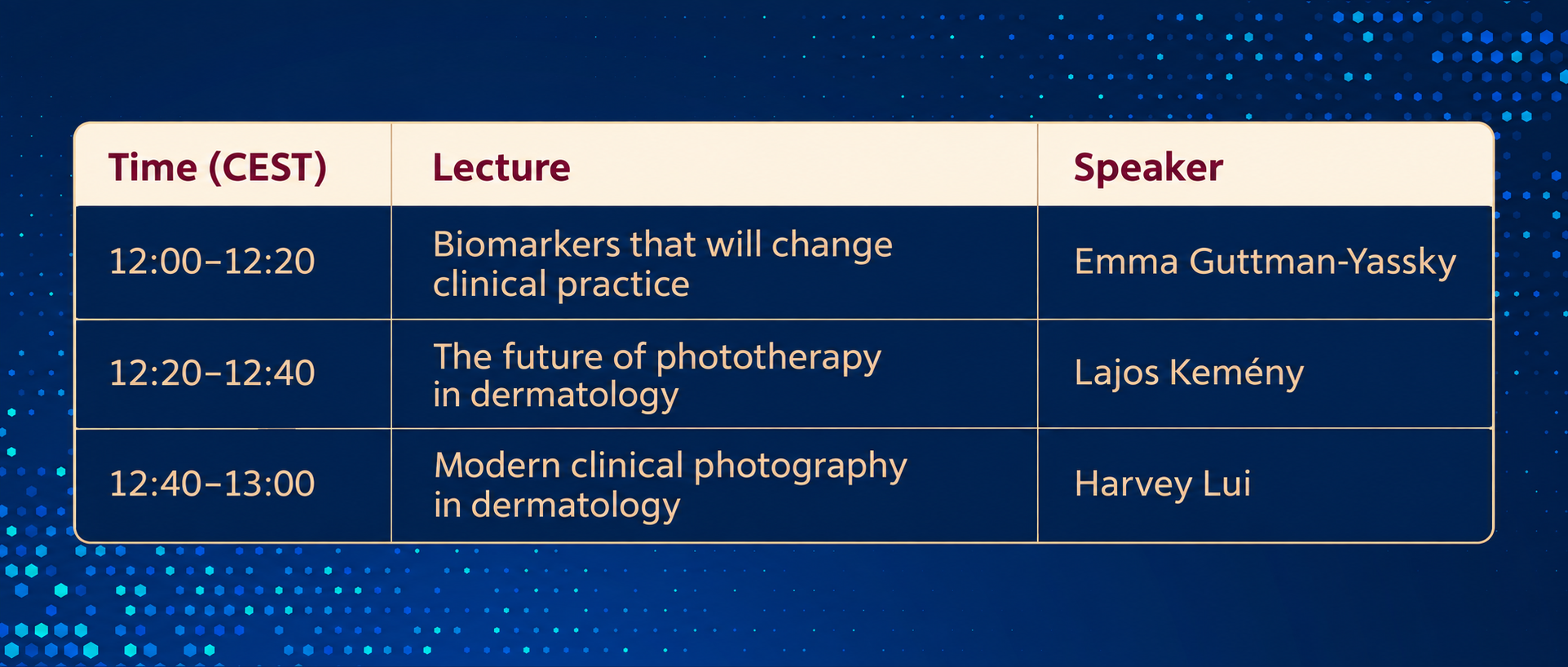
The 12:00 CEST plenary begins with Emma Guttman-Yassky examining how biomarkers could help guide treatment and monitor response in inflammatory skin disease. Lajos Kemény will then consider the future of phototherapy. Harvey Lui closes the session with a look at the opportunities and challenges of modern clinical photography.


Late-breaking research begins

The first late-breaking session, from 14:15 to 15:45 CEST, brings new data across several conditions. Presentations to watch include:

  •       Hidradenitis suppurativa: Alexa B. Kimball will present Phase 2b results for tulisokibart.
  •       Alopecia areata: Arash Mostaghimi will discuss bempikibart and hair regrowth in severe disease.
  •       Discoid lupus erythematosus: Victoria Werth will present Phase 2 efficacy and safety results for daxdilimab.

The second session runs from 16:00 to 17:30 CEST, with atopic dermatitis featuring prominently:

  •       Zumilokibart: Melinda Gooderham will present results from the Phase 2 APEX study.
  •       Lunsekimig: Robert Bissonnette will share findings from the Phase 2b VELVET trial.
  •       Lebrikizumab: Patrick Brunner will present 16-week results in atopic hand and foot dermatitis.

JAK inhibitors under discussion

Running alongside the late breakers is a two-part focus session on JAK inhibitors, bringing together the science behind these treatments and the decisions clinicians face when prescribing them.

In the first part, Melinda Gooderham will explain their mechanism of action before Bruno Duarte examines emerging JAK inhibitors and combination approaches. Ignasi Figueras-Nart will address safety, a key consideration when selecting patients and monitoring treatment. Seemal Desai will then review the evidence for long-term use, followed by a discussion and Q&A.

The second part turns to their use in specific conditions. Axel De Greef will discuss JAK inhibitors in alopecia areata, Stephan Weidinger in atopic dermatitis, and Annunziata Dattola in vitiligo. Lajos Vince Kemeny will close by examining the evidence for off-label use.


Evening keynote: From COVID-19 to the infodemic

The day closes with a plenary session and keynote lecture, running from 17:45 to 19:00 CEST in Hall A. Following welcome addresses from EADV President Branka Marinovic and Austrian Society of Dermatology President Robert Muellegger, and an introduction from Lidia Rudnicka, Salim Abdool Karim will deliver the keynote lecture, ‘From COVID-19 to the infodemic: Implications for the future.


More sessions to watch

The day also offers a series of update sessions on developments that could affect clinical practice. Topics include hidradenitis suppurativa, vitiligo, oral disease, Mohs surgery, chronic skin ulcers, and sexually transmitted infections. Other sessions will examine laser- and energy-based devices, aesthetic dermatology interventions, and dermatology in aging skin, plus much more.

touchDERMATOLOGY will be covering the latest data, expert perspectives, and clinical takeaways from EADV 2026.


Disclosures: This article was prepared by touchDERMATOLOGY as part of its independent congress coverage. No fees or funding were associated with its publication.

Editor: Gina Furnival 

touchDERMATOLOGY  coverage of EADV 2026: This content has been developed independently by Touch Medical Media for touchOPHTHALMOLOGY. It is not affiliated with the EADV. Views expressed are the speaker’s own and do not necessarily reflect the views of Touch Medical Media. 


Register now to receive the touchDERMATOLOGY newsletter!

Don’t miss out on hearing about our latest peer reviewed articles, expert opinions, conference news, podcasts and more.

DERMATOLOGY Newsletter banner

Share
Facebook
X (formerly Twitter)
LinkedIn
Via Email
Mark CompleteCompleted
BookmarkBookmarked
Copy LinkLink Copied
Open Nav
touchConference Hub
Section 3 of 3 Part 3 of 3

touchDERMATOLOGY coverage of EADV Congress 2026

Prev Part
touchConference Hub

touchDERMATOLOGY coverage of EADV Congress 2026

Late-breaking data

Further APEX data supports zumilokibart's potential as a less frequent dosing biologic option for atopic dermatitis; Melinda Gooderham

Further APEX data supports zumilokibart’s potential as a less frequent dosing option for atopic dermatitis

Part B of the phase 2 APEX trial evaluated three zumilokibart dosing regimens in adults with moderate-to-severe atopic dermatitis. All three met the primary endpoint at Week 16, with findings supporting mid dose selection for phase 3. Dr Melinda Gooderham discusses the efficacy and safety results from both Part A and Part B and what they could mean for clinical practice and those living with AD.
Abdakibart in hidradenitis suppurativa: What we learned from LOTUS; Martina Porter

Abdakibart in hidradenitis suppurativa: What we learned from LOTUS

Could abdakibart offer a new treatment option for hidradenitis suppurativa? Dr Martina L. Porter discusses encouraging findings from the phase 2 LOTUS trial, including improvements in disease severity and draining tunnels, alongside a reassuring safety profile over 16 weeks, and considers what these results could mean for clinical practice.
Safety of dupilumab in pregnancy explored in final registry results

Safety of dupilumab in pregnancy explored in final registry results

For women taking dupilumab to manage atopic dermatitis or asthma, limited pregnancy safety data can make treatment decisions challenging. Dr Christina Chambers discusses reassuring findings from a registry study of 539 pregnancies and how they could help clinicians counsel women who are pregnant or planning a family.

JAKPPPOT investigates the feasibility of a definitive JAKi trial in palmoplantar pustulosis

Encouraging findings from JAKPPPOT support the feasibility of a definitive randomized controlled trial of Janus kinase inhibitors in palmoplantar pustulosis and provide an exploratory estimate of treatment effect. We spoke with Dr David Gleeson about the results presented at EADV 2026 and their implications for future research.
0 mins

Topical RLS-1496 reduces actinic keratosis lesion counts

RLS-1496 1% cream is an investigational senotherapeutic treatment that inhibits GPX4. It aims to target senescent cells, potentially offering a new approach to treating actinic keratosis (AK). Encouraging findings from a phase 1b/2a, multicenter, open-label study were presented at EADV 2026. We spoke with Dr Mary Spellman, who presented the findings, about the results and their implications for the treatment’s future development.
Show All...

Expert insights

Sonelokimab shows potential in treating palmoplantar pustulosis in LEDA trial

Sonelokimab shows potential in treating palmoplantar pustulosis in LEDA trial

Sonelokimab showed encouraging results in the phase 2 LEDA trial in adults with palmoplantar pustulosis. Dr Nina Magnolo discusses the findings, including a mean 64% reduction in disease severity at Week 16, and their potential implications for patients.
Mario Valenti, bimekizumab in hidradenitis suppurativa

Real-world outcomes of bimekizumab in hidradenitis suppurativa

How does bimekizumab perform in everyday clinical practice? An Italian multicenter study reported improvements in disease activity, pain, and quality of life in people with hidradenitis suppurativa, with no unexpected safety signals. Dr Mario Valenti shares the findings and his perspective with touchDERMATOLOGY.
Prof. Dédée Murrell; The Women’s Dermatologic Society

Drug repurposing to advance treatment for rare genetic skin diseases

Drug repurposing could offer new treatment opportunities for rare genetic skin diseases. Prof. Dédée Murrell discusses the rationale for exploring existing medicines, progress in epidermolysis bullosa, and how a new trial aims to match treatments to patients’ inflammatory profiles rather than their genetic subtype.
Maria-Angeliki Gkini

EADV 2026: Psoriasis highlights and implications for clinical practice

On Day 2 of the EADV 2026 congress, we were delighted to speak with touchDERMATOLOGY Editorial Board member, Dr Maria Angeliki Gkini who shared her highlights from key psoriasis sessions and discussed what these developments could mean for clinical practice.
Prof. Dédée Murrell; The Women’s Dermatologic Society

The Women’s Dermatologic Society at EADV 2026

What did the Women’s Dermatologic Society bring to EADV 2026? Explore session highlights spanning blistering diseases, skin cancer, scarring alopecias, and more. Prof. Dedee Murrell introduces the society’s focus on mentorship, explains why the session is worth watching, and shares why dermatologists should consider joining.

Could rezpegaldesleukin offer long-term remission in atopic dermatitis?

New 52-week REZOLVE-AD data showed durable responses with monthly and quarterly rezpegaldesleukin (REZPEG) maintenance dosing in atopic dermatitis. Prof. Thomas Bieber discusses the findings and the potential for long-term remission and disease modification, highlighting the further evidence needed to explore these goals.
Dr Melinda Gooderham reflects on her EADV 2026 highlights, including updates in JAKi, zasocitinib vs. deucravacitinib, and the ICONIC-TOTAL findings on icotrokinra in psoriasis.

EADV 2026 highlights with Dr Melinda Gooderham

What were the key dermatology updates at EADV 2026? Dr Melinda Gooderham shares her highlights, exploring the Janus kinase (JAK) inhibitors session, new data comparing zasocitinib with deucravacitinib, and 2-year findings from ICONIC-TOTAL evaluating icotrokinra.
Ashraf Badawi
Ashraf Badawi

Key updates in the field of laser and energy-based devices

From pruritus and burn scars to cutaneous neurofibromas, Prof. Ashraf Badawi explores some of the new directions for lasers and energy-based devices discussed at this years EADV congress.

Study links glucagon-like peptide-1 receptor agonist use with nail disorders

Could glucagon-like peptide-1 receptor agonists affect nail health? A multinational study presented at EADV 2026 found nail disorders were reported more frequently among users, with nearly sevenfold higher odds of nail detachment. Prof. Bianca Maria Piraccini discusses the findings and why further clinical assessment is needed.
Show All...
Currently viewing

News

3 mins

touchDERMATOLOGY announces new media partnership with the EADV Congress

Through our new collaboration, we will work together to increase the visibility of important developments in dermatology, from the latest clinical research and scientific advances to key society news and updates. As part of the partnership, touchDERMATOLOGY will also bring our community independent coverage directly from the EADV Congress, including the latest data, expert perspectives, key clinical takeaways and onsite interviews with leading specialists.
3 mins

Your quick guide to keynote and plenary sessions at EADV 2026

With EADV Congress 2026 just around the corner, there is plenty to look forward to in Vienna from 30 September to 3 October. If you are joining this year, whether onsite or online, the keynote and plenary sessions are well worth making time for in your congress schedule.

Day 1: Late breakers, JAK inhibitors and keynote lecture open EADV 2026

The EADV Congress opens in Vienna on Wednesday, 30 September. Day 1 highlights include a midday plenary, two late-breaking sessions, a focus on JAK inhibitors, and a closing keynote on the COVID-19 pandemic and the infodemic.
Close Popup