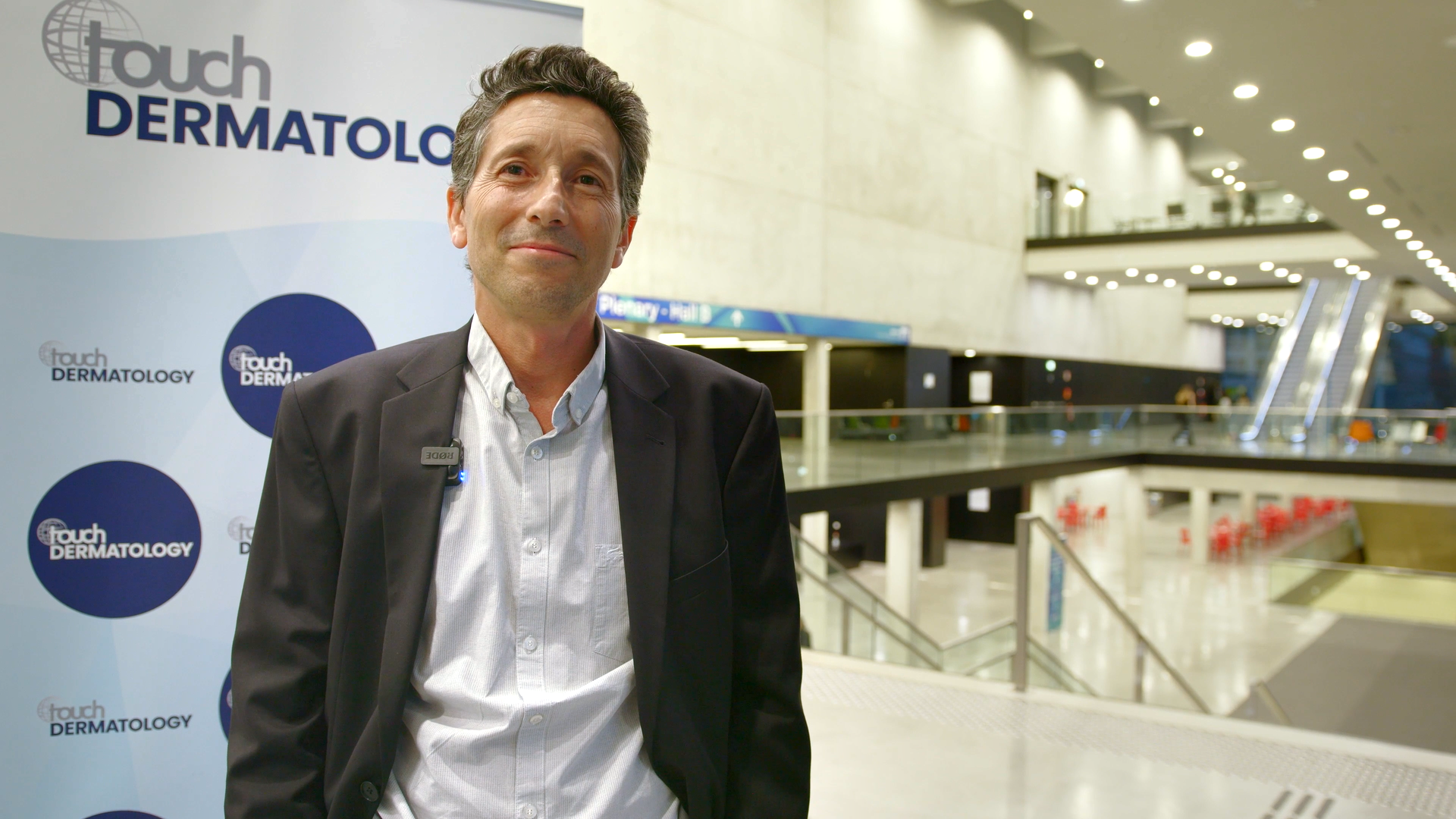
Thomas Bieber discusses the latest REZOLVE-AD findings and the potential for REZPEG to offer long-term remission and, potentially, disease modification in AD.
Rezpegaldesleukin (REZPEG) is an investigational interleukin-2 (IL-2) receptor pathway agonist designed to increase the number and enhance the function of regulatory T cells (Tregs). It represents a novel therapeutic approach being investigated for atopic dermatitis (AD). It is hoped that by targeting a different immune pathway, REZPEG could offer sustained disease control with less frequent maintenance dosing.
New 52-week data from the phase 2b REZOLVE-AD study (NCT06136741), including results from its 36-week blinded maintenance period, were presented at the EADV 2026 Congress. The findings showed that monthly and quarterly maintenance dosing produced durable responses, with further improvements in the signs and symptoms of AD through Week 52, including complete disease clearance in some patients.
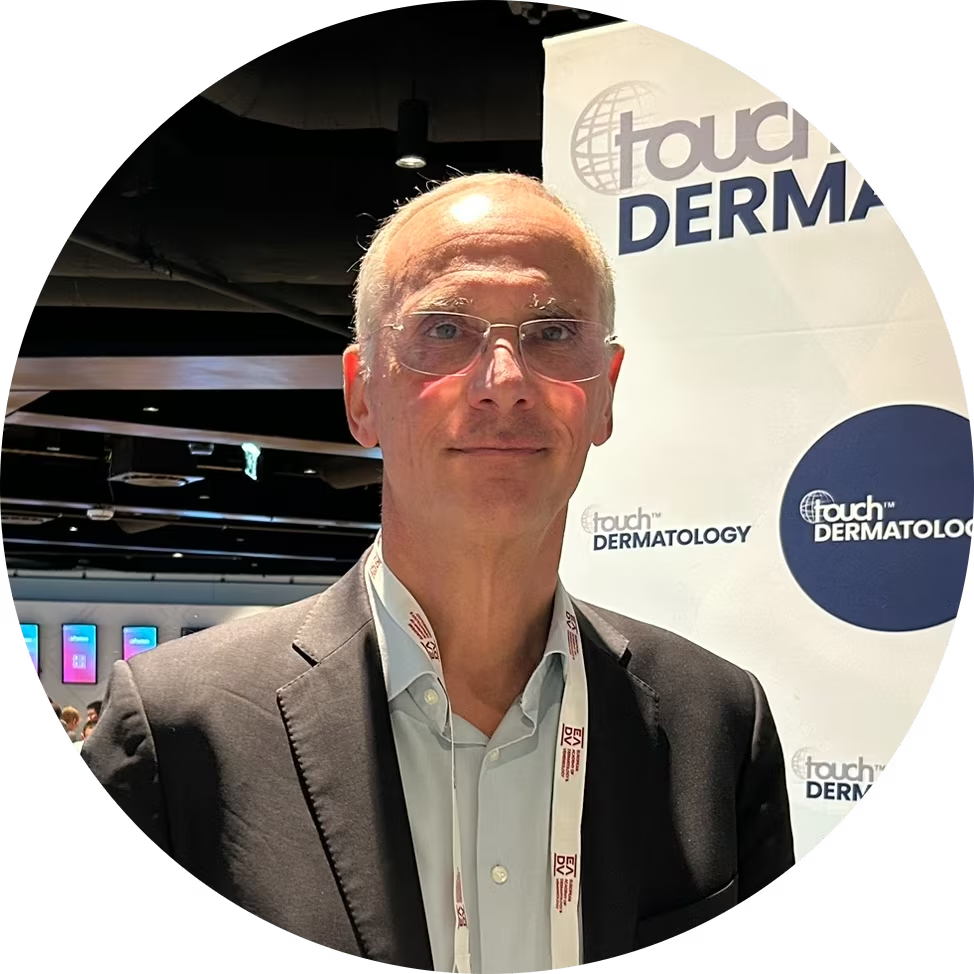
Following his presentation, we spoke with Prof. Thomas Bieber (Ludwig-Maximilians University Hospital, Munich, Germany) about the study’s findings and their potential implications for clinical practice and people living with AD.
Q. What has REZOLVE-AD shown about the efficacy and durability of response of REZPEG in AD?
The phase 2b REZOLVE-AD trial of REZPEG in AD has demonstrated clear efficacy compared with placebo. However, when discussing efficacy, people typically compare this drug with dupilumab, which is considered the gold standard. In my opinion, a common mistake is to compare the Week 16 results for dupilumab with those of every other drug in development, as these drugs have different mechanisms of action and different timelines for clinical response.
For example, treatments such as REZPEG have the potential to show efficacy at Week 16, but their greatest value may lie in what we see at Week 52 and beyond. This relates to its mechanism of action: the Treg population needs time to expand, and those cells then need time to influence the ongoing inflammation.
I would say that the potential of REZPEG lies in the possibility of achieving long-term remission, perhaps even after treatment has stopped. It belongs to a new generation of therapies with which we hope that, after treating patients for 1 year or 1.5 years, we might be able to stop treatment completely if their disease is fully controlled.
If achieved, this could transform the lives of patients and their families.
Q. What has the study demonstrated in terms of safety and tolerability of REZPEG?
Safety is always an important consideration in clinical development. So far, we have phase 2b results from a few hundred patients, rather than several thousand.
The safety profile has been encouraging. Apart from some injection site reactions, we have not seen any major safety signals or other notable findings compared with placebo. These findings give us confidence, but we need to retain that caveat about the number of patients treated. Larger studies involving several thousand patients will be needed to characterize the safety profile more fully.
In terms of tolerability, we know from oncology trials that injecting cytokines such as IL-2 can cause transient local reactions. Encouragingly, we have seen these reactions decrease over time in most patients in this trial. I believe only one patient stopped treatment because of an injection site reaction. This suggests that, for most patients, these reactions were manageable and did not lead them to discontinue treatment.
Q. What are the next steps in exploring its potential in these populations?
The next step will be to investigate what happens if treatment is stopped after 1 year. Could patients achieve the ultimate goal of long-term remission without continued treatment?
This is the potential for disease modification that we hope to explore: whether enhancing the Treg response could suppress the ongoing chronic inflammation and allow disease control to persist after treatment has stopped. This approach may also have potential in other inflammatory diseases.
If we could achieve that goal, it could transform patients’ lives and, in my view, represent a major advance in managing AD. However, we must remain cautious and wait for further evidence to establish whether this drug can deliver that outcome.
In addition, we should not expect a single treatment to work for everyone. AD is complex, both in its clinical presentation and its underlying immunology, so not all patients would be expected to achieve long-term remission. However, if around half, or perhaps more, of those treated could achieve that goal, it would be a remarkable outcome.
Related abstract: Bieber T, Rosmarin D, Warren RB, et al. Rezpegaldesleukin provides durable and deepening improvements in the signs and symptoms of atopic dermatitis with monthly and quarterly dosing: Results from the phase 2b REZOLVE-AD maintenance part of study. Presented at: EADV Congress 2026, Vienna, Austria, 1 October, 2026. Abstr#1732.
Cite: Real-world outcomes of bimekizumab in hidradenitis suppurativa. touchDERMATOLOGY. 16 October, 2026.
Disclosures: No funding was received for the publication of this content. We thank Prof. Bieber for sharing his expert perspectives. Prof. Bieber discloses current or previous roles as a speaker and/or consultant for AbbVie, Aclaris, Almirall, AnaptysBio, Apogee, Arcutis, Artax, Attovia, Bambusa, Belenos, Biocryst, Biogeneration, BioVerSys, Bluefine, Böhringer-Ingelheim, Bristol-Myers Squibb, BYOME Labs, Cantargia, CellDex, Choate, Claris Venture, Corvus, DirigentBio, Domain Therapeutics, Eggle, EngImmune, Ennovate, Evommune, Forbion, Formycon, Galderma, Gilead, GSK, ImagGeneBio, Janssen, Kyowa/Kirin, Kymera, LEO, Lilly, Mabylon, MSD, Micreos, Nektar, Nextech, Novartis, Pfizer, Pierre Fabre, Protagonist Tx, Samsung Bioepis, Sanofi/Regeneron, Scienta Lab, Serono, SwitchKine, TIRmed, Triton, Triveni, UCB, Union Therapeutics, UPStream Bio, WinWard, YUHAN, and Zurabio. He is the founder and chairman of the board of the nonprofit biotechnology company Davos Biosciences AG, within the international Kühne-Foundation. He is also the founder and senior medical advisor of Bieber Dermatology Consulting.
Editor: Gina Furnival, Head of Content
touchDERMATOLOGY coverage of EADV 2026: This content has been developed independently by Touch Medical Media for touchDERMATOLOGY. touchDERMATOLOGY was an official media partner of the EADV Congress 2026. touchDERMATOLOGY is not affiliated with the EADV. Views expressed are the speaker’s own and do not necessarily reflect the views of Touch Medical Media.