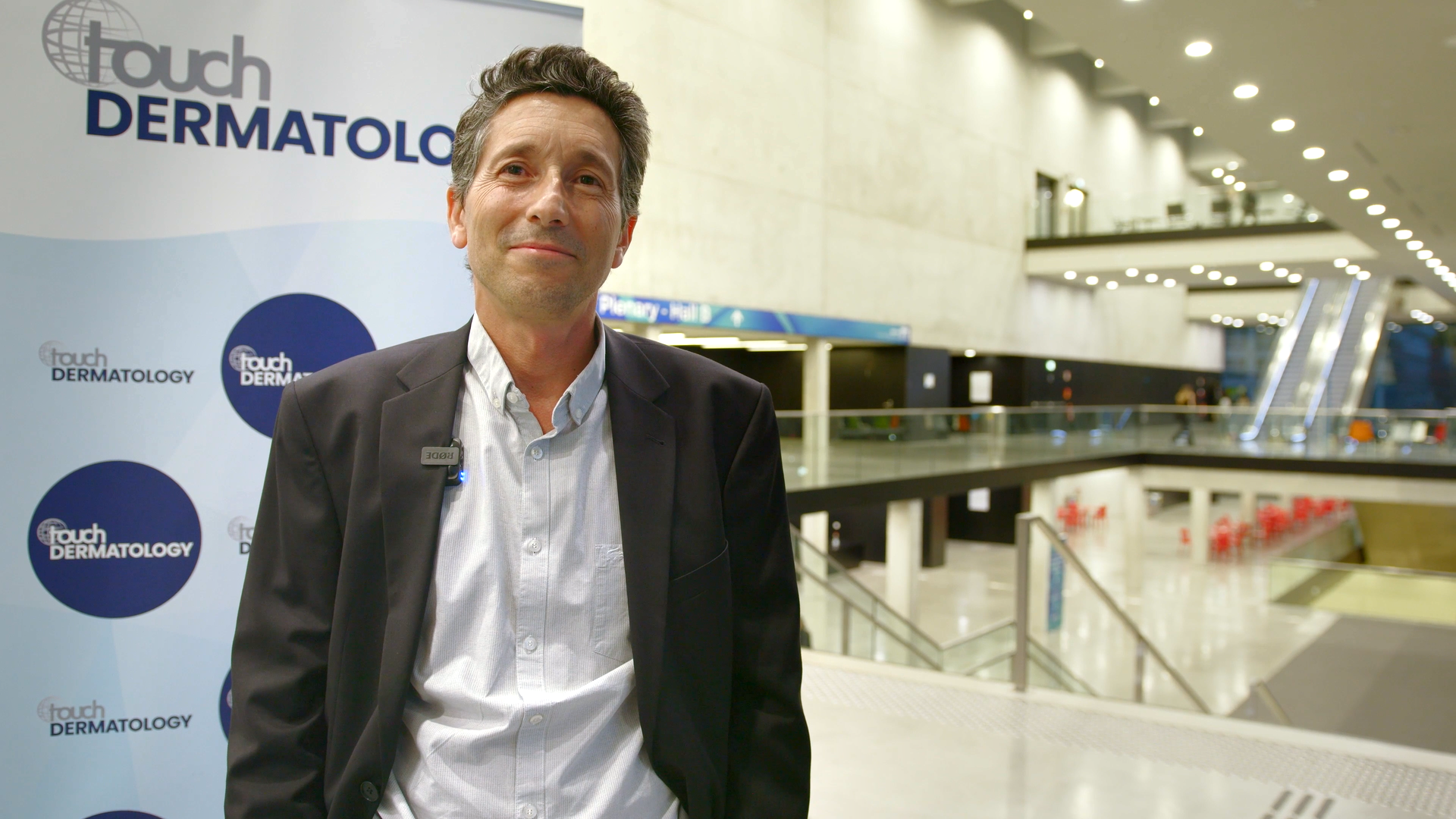
In the phase 2 LOTUS trial, abdakibart showed improvements as early as Weeks 2–4, with significant reductions in disease severity and lesion counts compared with placebo and a reassuring safety profile over 16 weeks.

 Biologics targeting tumor necrosis factor-α (TNFα) and interleukin-17A/F (IL-17A/F) are often prescribed when antibiotic therapy has been unsuccessful in HS. However, substantial improvements can remain difficult to achieve for many patients, highlighting the need for additional treatment options. Interleukin-1β (IL-1β), which acts upstream of TNFα and IL-17, is the target of the investigational agent abdakibart.
The double-blind, placebo-controlled phase 2 LOTUS trial evaluated abdakibart’s efficacy and safety over 16 weeks. Analyses examined changes from Baseline in IHS4, the proportions of participants achieving at least 55%, 75%, and 90% improvements in IHS4, and changes in individual and combined lesion counts.¹
We spoke with study investigator Dr Martina Porter (Harvard Medical School, Cambridge, MA, USA) about the study findings and their potential implications for people living with HS.
Q. How is abdakibart thought to work in treating hidradenitis suppurativa?
Abdakibart is an IL-1β antagonist. It differs from other IL-1 antagonists studied in HS because it specifically targets IL-1β, which is thought to be the main driver of the IL-1 pathway in HS.1
Other agents investigated in HS have inhibited IL-1α and failed in clinical trials. Lutikizumab, which is a little further ahead of abdakibart in development, targets both IL-1α and IL-1β, so abdakibart is a little different from these agents.
Abdakibart is also a monoclonal antibody with very high affinity, so it could potentially be effective even with low tissue penetration. We are still trying to figure out whether this makes a meaningful difference in HS, but theoretically, it seems like it could.
Q. Could you describe the design and key endpoints of the phase 2 LOTUS trial?
This was one of the largest phase 2 studies to date in HS. With growing concern about placebo response and the use of more stringent efficacy endpoints, larger trials may help us assess treatment effects more reliably.
The study compared two dosing regimens with placebo: a higher dose (600 mg loading dose then 300 mg SC given every 4 weeks) and a lower dose (Abdakibart 300 mg loading dose then 150 mg given every 2 weeks). There were around 80 patients in each group.
The primary endpoint, HiSCR75, was assessed at Week 16, when treatment ended. There was a short safety follow-up, but no crossover or continuation phase, which is something we are seeing more often in phase 2 trial designs.
Q. What were the key Week 16 findings?
The higher-dose group also received a higher loading dose, and we started to see separation from placebo in some outcome measures as early as Weeks 2 and 4.
The study met its primary endpoint, with just over 40% of patients in both dosing groups achieving HiSCR75 at Week 16, compared with around 25% in the placebo group. The placebo response was still relatively high, similar to that seen in the VELA trials, but the differences were statistically significant, with clear separation between both treatment groups and placebo.
We also looked at IHS4. What we have seen over time is that IHS4 and HiSCR tend to track closely together.
HiSCR does not directly measure improvements in draining tunnels, so a drug that works particularly well on these lesions might not have its full effect captured by that measure. IHS4, however, gives draining tunnels greater weight. The IHS4-55 and IHS4-75 results looked very similar to HiSCR50 and HiSCR75. There was also some separation for IHS4-90, although this was a trend rather than a statistically significant difference. At that level of response, we are looking at very small numbers of patients.
The overall change in lesion counts was significant across all lesion types. We saw a greater improvement from Baseline in the total IHS4 score in the higher-dose group. We also presented changes in inflammatory nodules, abscesses, and draining tunnels. These tend to improve together, which helps explain why HiSCR and IHS4 generally follow similar patterns.
The more IL-1 data I see, the more I think this mechanism may have a profound impact on draining tunnels. In the abdakibart dataset, we saw a large reduction in draining tunnels even early in the study.
Q. What did the study show about the two dosing regimens?
This is a trend we have seen in several trials: a higher loading dose can produce greater separation from placebo early on. That happened here in the higher-dose group, which received twice the loading dose of the lower-dose group.
Over time, though, the lower-dose group tends to catch up. I think that is probably because HS is a very heterogeneous disease, with a wide range of disease severity within a moderate-to-severe trial population. With many of these biologics, the different doses perform similarly at Week 16 in patients with more moderate disease. We often see greater separation between doses in patients with the most severe disease, who have very high Baseline IHS4 scores or draining tunnel counts.
In other trials, we often see the higher dose perform a little better early on in these patients, but the responses tend to become more similar by 6 months. In clinical practice, it is helpful to have different dosing options, particularly if there are differences in side effects. In this study, however, the safety profiles were reassuring and similar across both dosing groups.
I think in some cases it is helpful to give a higher dose to patients with more severe disease who need it. Obviously, from a regulatory perspective, differences in safety matter a lot, and further down the line, costs do too.
In general, the aim is to give the lowest, most effective dose that we can.
Q. What did the trial show about safety and tolerability over 16 weeks?
There were very few safety concerns. It was interesting to see because the study monitored a long list of adverse events (AEs) of special interest, particularly given the many comorbidities people with HS can have.
The most common AEs were headaches, followed by upper respiratory tract infections. These occurred at similar rates in the placebo and treatment groups, so there was no apparent safety signal.
The study also monitored potential concerns associated with the IL-1 pathway, such as neutropenia and leukopenia, neither of which occurred. There were no serious infections or deaths, and very few discontinuations due to AEs.
Overall, the safety profile looked reassuring. Laboratory values were not presented, so we could not assess those changes, but the AE data reported so far look encouraging.
Q. What could the LOTUS findings mean for treating hidradenitis suppurativa?
In HS, there is a particular focus on safety, probably because we treat many younger women of childbearing potential who may have concerns about these medications. Seeing such a safety profile is therefore reassuring.
The efficacy results for our treatments seem to be falling within a fairly small range. Without head-to-head trials, it is difficult to know which treatment to choose. I think abdakibart appears to fall within the range of results we have seen with adalimumab and bimekizumab, although we cannot make direct comparisons across trials.
If approved, depending on any requirements to use biosimilars or other treatments first, I think it could be a good first-line therapy. I have also been encouraging companies that it is really important to look more granularly at some of the data to find which patients are most likely to respond to some of these medications, because that will help guide some of our treatment decisions.
As I mentioned, abdakibart seems to work well in patients with quite severe disease and a lot of drainage, so I think it could have a particular role in that population.
Note: This transcript has been lightly edited to ensure clarity.
References
- Porter ML, Kimball AB, Doyle M, et al. Efficacy and safety of abdakibart (ABD), a humanized high affinity and potency IgG4 anti-IL-1β agent for treatment of moderate to severe hidradenitis suppurativa at Week 16; IHS4 subgroup and lesion type ANdT results of the Phase 2 placebo-controlled LOTUS Trial. Presented at: European Academy of Dermatology and Venereology (EADV) Congress 2026, Vienna, Austria, September 30–October 3, 2026. Abstr#269.
Cite: Abdakibart in hidradenitis suppurativa: What we learned from LOTUS. touchDERMATOLOGY. October 20, 2026.
Disclosure: No funding was received for the publication of this content. Thank you to Dr Porter for sharing her expert insights. Dr Porter discloses serving as a consultant and investigator for AbbVie, Avalo Therapeutics, Arcutis, Aristea Therapeutics, Eli Lilly and Company, Incyte, Janssen, Merck, MoonLake Immunotherapeutics, Navigator Biosciences, Novartis, Pfizer, Prometheus, Sanofi, Sonoma Biotherapeutics, UCB, Ventyx, and Zura Bio; serving as a consultant for Almirall, FIDE, Insmed, Oruka, Otsuka, Propeller Biosciences, Spyre, and TrifectaClinical/WCG; serving as an investigator for AnaptysBio, Bayer, Bristol Myers Squibb, OASIS Pharmaceuticals, and Regeneron; receiving royalties from Beth Israel Deaconess Medical Center; and receiving fellowship funding to her institution from AbbVie.
Editor: Gina Furnival, Head of Content
touchDERMATOLOGY coverage of EADV 2026: This content has been developed independently by Touch Medical Media for touchDERMATOLOGY. touchDERMATOLOGY was an official media partner of the EADV Congress 2026. touchDERMATOLOGY is not affiliated with the EADV. Views expressed are the speaker’s own and do not necessarily reflect the views of Touch Medical Media.