From pruritus and burn scars to cutaneous neurofibromas, Prof. Ashraf Badawi explores some of the new directions for lasers and energy-based devices.

 New concepts and new directions for lasers and energy-based devices featured across several sessions at the 2026 European Academy of Dermatology and Venereology (EADV) Congress, including this year’s European Society for Lasers and Energy Based Devices in Dermatology (ESLD) session.
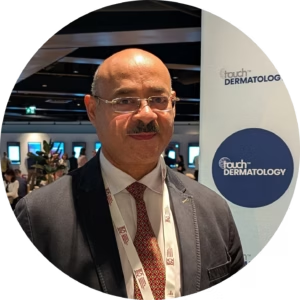
We spoke with ESLD President and session chair Prof. Ashraf Badawi (Oakville, Canada) to hear his highlights and key takeaways for clinicians. From potential applications in pruritus and cutaneous neurofibromas to optimizing the management of burn scars, there was plenty to discuss about the expanding role of these technologies beyond aesthetic applications.
Prof. Badawi also shared highlights from the Lasers and energy-based devices updates session and discussed his current research into radiofrequency microneedling.
Q. Which emerging applications and approaches stood out in the ESLD session?
Transcript: We had a very rich session, with talks covering a range of applications. One of the interesting talks was about treating pruritus with a fractional CO₂ laser (Samia Esmat, Cairo, Egypt). This was new to me, and it was interesting to learn that we can use a laser to address a problem like this. For people living with pruritus, this can be a very irritating feeling. And in many cases, this is not alleviated by the normal medications, the classical medications like antihistamines and so on. So, to know that a procedure like a CO₂ laser, used in a mild way, can improve this situation is excellent. The other thing is, there was a nice talk about using picosecond lasers to treat skin problems like pigmentation (Ahmed Sadek, Cairo, Egypt). This is the classic use. But also using them for rejuvenation and improving the quality of the skin, with a mode which is not associated with downtime or complications, even in dark or tanned skin. This was a new development in the field of lasers. On the other hand, there was a very interesting talk about how early we can use the laser after trauma and after burns in order to avoid the scarring (Abeer Tawfik, October City, Egypt). Studies now are showing that we are supposed to start treatment very early, in the first few weeks after the injury to the skin, as opposed to what we have been doing for many years, which was to wait 6 months after the trauma. But now the understanding is different, and we have to start much earlier. There was an interesting talk about using high-intensity focused ultrasound (HIFU) in cutaneous neurofibromas, which highlighted how, instead of using HIFU only for rejuvenation, we can potentially use it to treat certain skin diseases (Katrine Elisabeth Karmisholt, Copenhagen, Denmark). I believe this is a great concept because, when HIFU has been used for rejuvenation, it sometimes causes scarring. However, when the aim of treatment is to destroy certain tissue in the skin without damaging the surface of the skin, then this could be a great application for HIFU. So again, this is a new concept in a different direction. In summary, I believe those dermatologists who attended the ESLD session yesterday came out of the room with some very nice concepts to implement in practice, starting from tomorrow. Note: This transcript has been lightly edited with AI assistance (ChatGPT v6.1 Sol) to ensure clarity.
Q. What were your key take-home messages from the laser and energy-based devices session?
The first two talks of the session, which focused on ablative (Sarah Elyoussfi, London, UK) and nonablative lasers (Raphaël André, Geneva, Switzerland), explored how these treatments may influence gene expression. This is an interesting concept, first introduced around 15 years ago, when we began to demonstrate that certain skin treatments could alter gene expression, reducing the activity of genes that become more active with age and increasing the activity of genes that become less active as we age.
These changes can help restore a more youthful pattern of gene expression, representing a form of skin rejuvenation. It is therefore important for practitioners to distinguish between procedures that aim to restore the skin’s structure and function and those that offer a short-term improvement in appearance.
When we inject botulinum toxins or fillers, we can improve the skin’s appearance, but the underlying aging process continues. Without addressing the associated changes in skin structure and function, these will continue to deteriorate over time. By contrast, procedures that target different layers of the skin with the aim of restoring their structure and function may achieve a more regenerative effect. Changes in gene expression provide further evidence of the potential for these treatments to promote skin rejuvenation.
During the session, I also gave a talk on radiofrequency (RF) and plasma devices. I began by asking, “Do you know when the first RF device was introduced?” No one answered, but it was 2002, while the first plasma device was introduced in 1995. These technologies have therefore been around for many years, although interest in them often fluctuates with marketing trends.
Some technologies become very popular, only to fall out of favor when they fail to deliver the promised results or concerns emerge about potential harm to the skin. They may then return with a new marketing campaign, generating renewed interest.
My aim was to explain the scientific principles behind these devices and their limitations, helping practitioners distinguish evidence-based claims from marketing messages so they can set realistic, scientifically grounded expectations.
Q. What prompted your research into radiofrequency microneedling, and what are you aiming to clarify?
We are currently preparing an article on radiofrequency microneedling. Having used this technology for many years, I consider it a valuable option for improving skin quality and treating certain skin conditions. However, the FDA safety communication issued about a year ago prompted me to explore the reasons behind the reported complications,1 including whether aggressive treatment parameters, device quality, or treatment protocols may have contributed.
Our research aims to examine the efficacy and safety of radiofrequency microneedling and the factors that influence treatment outcomes. This includes understanding the condition being treated, recognizing the technology’s limitations and developing appropriate treatment protocols. We also want to highlight what practitioners should avoid to help minimize the risk of complications.
Meeting information: This information was presented at the EADV Congress 2026, Vienna, Austria, September 30–October 3, 2026.
References:
- US Food and Drug Administration. Potential risks with certain uses of radiofrequency (RF) microneedling: FDA safety communication. 2025. Available at: www.fda.gov/medical-devices/safety-communications/potential-risks-certain-uses-radiofrequency-rf-microneedling-fda-safety-communication (accessed October 13, 2026).
Cite: EADV 2026: Key updates in the field of laser and energy-based devices. touchDERMATOLOGY. 15 October, 2026.
Disclosures: No funding was received for the publication of this content. Thank you to Prof. Dr Ashraf Badawi for sharing her expert insights. Prof. Badawi is the President of the ESLD.
Editor: Gina Furnival, Head of Content
touchDERMATOLOGY coverage of EADV 2026: This content has been developed independently by Touch Medical Media for touchDERMATOLOGY. touchDERMATOLOGY was an official media partner of the EADV Congress 2026. touchDERMATOLOGY is not affiliated with the EADV. Views expressed are the speaker’s own and do not necessarily reflect the views of Touch Medical Media.