

touchDERMATOLOGY coverage from EADV 2025:
The 2025 European Academy of Dermatology and Venereology (EADV) Congress brought over 20,000 delegates to Paris this September, showcasing the latest advances in the field. With more than 180 sessions and 600 expert speakers, the meeting highlighted innovations ranging from new biologics and novel agents to real-world evidence and patient-centred care. In this article, we share key highlights from the congress, spotlighting the breakthroughs and clinical insights set to shape the future of dermatology practice.
Linda Stein Gold on chronic hand eczema
The EADV has been a really wonderful conference this year. I had the opportunity to speak on chronic hand eczema and the topical pan-JAK inhibitor, delgocitinib, which was just FDA approved in the USA. What is fascinating about this drug is that it’s the first time we’re seeing a JAK inhibitor that does not have a box warning associated with it. So that is really exciting for us in the USA, where we have not had an FDA approval for chronic hand eczema in the past. This drug was shown to be efficacious, safe and well tolerated, and useful across all different aetiologies of chronic eczema.
See the full interview “First-in-class, oral peptide, icotrokinra shows superior efficacy in ICONIC-ADVANCE trials for plaque psoriasis” here.
Raj Chovatiya on atopic dermatitis
 From a dermatology standpoint, we saw a lot of really exciting disclosures in different inflammatory disease states, which is where I pay the closest attention. Atopic dermatitis is the one that gave us a lot to chew on. We saw some readouts of late phase actives looking at unique biology that we haven’t had therapies for. It is exciting that there might be additional pathways that we are targeting and early phase actives that suggest newer pathways as well. Given the leaps and bounds that we have made in psoriasis over the past 25 years, it is awesome to see that we are trying to have the same trajectory in other diseases, hopefully we’ll see this in atopic dermatitis.
See the full interview “Roflumilast foam 0.3% proves highly effective at controlling seborrheic dermatitis across diverse skin and hair types” here.
Olivier Gaide on cutaneous oncology
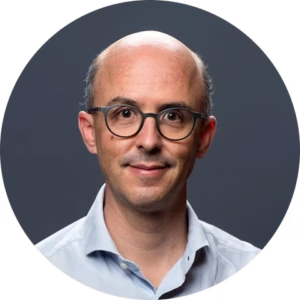
What have been your highlights from EADV 2025?
One of my highlights from the EADV congress was the discussion on global dermatology and dermatology being recognized by the World Health Organisation’s decision-making office, the World Health Assembly. For a long time, dermatologists have been seen as people who practice aesthetics and, at last, the WHO recognises the importance of skin for general health. The WHO has also produced a list of drugs it deems extremely important for the general population and the list includes drugs which are important to treat psoriasis, but also simple things like emollients for atopic dermatitis and finally the use of sun protective measures, including sunscreens, for patients with albinism in every country.
It really puts dermatologists on the map and this has a very important global aspect to it, because it will help us to draw new talent and young dermatologists, and encourage them to practice dermatology and not only aesthetic procedures. This will have implications for our future, and we should capitalise on that and remind everyone that we are doing a great service for the general health of the population – it’s motivating and it’s important.
What were the key presentations in cutaneous oncology?
I went to the basal cell carcinoma and squamous cell carcinoma session. One of the important discussions at the moment in the field of squamous cell carcinoma is the use of neoadjuvant immunotherapy, which is becoming a standard. This has already been the case for melanoma, but squamous cell is joining the field and we see it as a novel standard-of-care.
See the full interview “Encouraging interim results for topical bimiralisib in actinic keratosis” here.
Dedee Murrell on acne
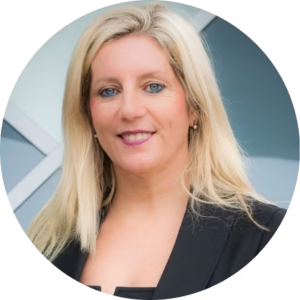 What have you been your personal highlights from EADV?
My favourite talk this year at EADV was the keynote talk by Lucy Cooke, an author who has published a lot on animal behaviour. The talk was on the animal kingdom and how in some species women are at the top of the tree and then in other species, there is an alpha male. She gave this fascinating lecture about sloths and how being slow and sloth-like helps them to survive. For me, that has been the highlight of the conference, something very different and from a really entertaining and intelligent woman who studied zoology, animal behaviour, and anthropology at Oxford.
What were the key presentations in acne?
The session I was speaking in about acne had two very interesting other speakers: Dr Jerry Tan from Canada and Dr Latanya Benjamin from the USA. Jerry’s talk was very interesting on the role of testosterone. He discussed how in some syndromes, if a boy is castrated at a young age then they will never develop acne, proving the role of testosterone. Not a recommended treatment, he joked. He also discussed other syndromes in which there is no testosterone activity at the receptors.
Latanya talked about social media and the role that it is playing in stigmatising teenagers – an important role, because teenagers are now getting bullied online as well as in the classroom. Teenagers have these personal profiles, but are too scared to put pictures of themselves online. This presentation also covered the explosion of non-medical people recommending diets and completely unfounded treatments to patients. Latanya was advocating for doctors, dermatologists in particular, to be more active online in providing truthful information to patients.
See the full interview “Adult acne in women: Causes, emotional toll, and the latest breakthrough treatments” here.
Ashraf Badawi on pigmentary disorders
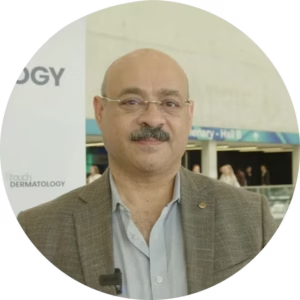
What were the most exciting updates in pigmentary disorders at EADV 2025?
I think one of the most exciting developments is the growing use of combination therapy. In the past, we typically used lasers separately and at different stages of treatment. Now, we have a much better understanding that by combining multiple wavelengths, and sometimes different types of lasers, such as fractional lasers with Q switched or picosecond lasers, we can significantly enhance and improve treatment outcomes. There has also been growth in our understanding of the underlying issues and how to use the tools we already have, including lasers and other approaches, more effectively and in combination.
Based on what you’ve seen at EADV, where do you think the field of pigmentary disorders is headed in the next few years?
There have been some pharmacological advancements, including new biological drugs, which can enhance the effectiveness of existing treatments. Combining lasers or other energy devices with these drugs or biologicals will definitely put us in a much stronger position than we were a few years ago.
Pigmentary disorders remain one of the most challenging areas in the use of lasers and devices. Expectations in this field are often unrealistic, as many people believe that a few laser sessions will completely remove a tattoo or pigmentation, which is not yet the case. Combining different wavelengths or different types of lasers within the same session can improve outcomes, but patient education is key. It is essential to help patients understand that achieving significant pigmentation removal is a lengthy process.
See the full interview “Adult acne in women: Causes, emotional toll, and the latest breakthrough treatments” here.
Olufolakemi Cole-Adeife on acne, skin cancer, and skin of colour in dermatology
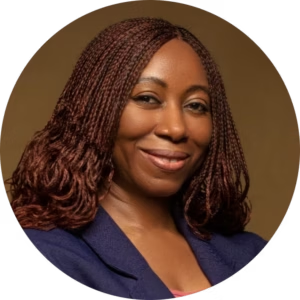 This is my first time at EADV and it is a very large and well organised conference, with thousands of dermatologists from across Europe and the world. So far I’ve attended a lot of very interesting sessions, one on acne and the diet and then how to treat acne scars. Acne is the most common condition I see in Nigeria and treating acne in darker skin has its nuances, so I’m always interested in learning new things about acne, the role of the diet and some of the new therapies. We also have a lot of people who have challenges with hair growth and hair loss, so it has been interesting to learn about hair disorders,
There was also a session on skin of colour in dermatology and I attended that, though briefly, it was really interesting and fantastic. Its day 2 and I’m looking forward to some other sessions, there are some on atopic dermatitis, which I’m interested in. Then sessions on skin cancer, because I treat people with albinism and manage the skin cancers that they have, usually head and neck skin cancers with BCCs and SCC, so I’m interested in the session on that as well. I think it’s been really amazing so far and I’m still looking forward to the remaining days of the conference.
See the full interview “Confronting the global rise of drug-resistant ‘super’ fungal skin infections” here.
Teerapong Rattananukrom on fungal skin infection

What were your highlights in fungal skin infection research at EADV this year?
This year, my favourite session focused on fungal resistance and new techniques for identifying the causative agents of infection. There is growing awareness of Trichophyton indotineae, an emerging pathogen that can cause recalcitrant infections and it is becoming increasingly prevalent. Early detection using molecular tools, such as PCR sequencing or other molecular diagnostics can support faster diagnosis, help shorten treatment duration, and ensure patients receive the most appropriate therapy.
Were there any new approaches presented that could change the way we manage fungal skin infections?
I think two areas stood out. Firstly, advances in multi-omics, PCR, and sequencing technologies which are helping clinicians identify fungal and dermatophyte infections more rapidly, which can significantly shorten the time between diagnosis and treatment. Secondly, several new topical and systemic antifungal agents are in development, some with novel mechanisms of action. These may expand our treatment options, especially in cases where conventional therapies have failed due to resistance.
Flavia Manzo Margiotta’s personal highlights
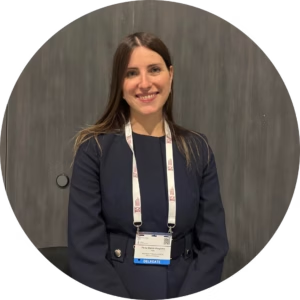
During the conference, I had the opportunity to hear from colleagues coming from all around the world about new drugs and new targets in inflammatory disease, this was very exciting! There are key opinion leaders and you can see the real time application of guidelines and their interpretation.
See the full interview “Benefits of ultra-high frequency ultrasound for personalised alopecia treatment” here.
Aaron Mangold’s personal highlights
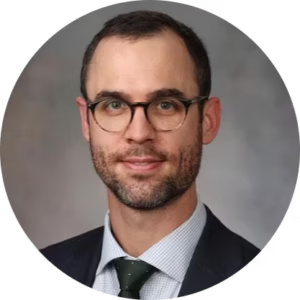 My highlights, as somebody who practises in the USA, is to see all the ongoing, exciting research happening in Europe, not just in clinical trials, but also in basic science research. I think it is an opportunity to learn from others, as well as an opportunity to have multiple meaningful collaborative meetings that wouldn’t happen at other congresses; there are different global teams that are there to share their experience.
See the full interview “Brepocitinib: A TYK2/JAK1 inhibitor as targeted oral therapy for dermatomyositis” here.
More highlights from EADV 2025.
This content has been developed independently by Touch Medical Media for touchDERMATOLOGY. It is not affiliated with the European Academy of Dermatology and Venereology (EADV). Views expressed are the speaker’s own and do not necessarily reflect the views of Touch Medical Media.
Cite: Expert insights from EADV 2025: Translating evidence into dermatology practice. touchDERMATOLOGY. 21 October, 2025.
Editors: Gina Furnival & Victoria Smith.
Related content

- How dupilumab is set to transform bullous pemphigoid treatment
- #AAD25: Essential updates in atopic dermatitis and psoriasis
- 3 Questions with Alicia Little: touchDERMATOLOGY Future Leader 2025
Register now to receive the touchDERMATOLOGY newsletter!
Don’t miss out on hearing about our latest articles, expert opinions, conference news, podcasts and more.