EADV

With EADV Congress 2026 just around the corner, there is plenty to look forward to in Vienna from 30 September to 3 October. If you are joining this year, whether onsite or online, the keynote and plenary sessions are well worth making time for in your congress schedule.

New collaboration will bring onsite EADV Congress coverage, expert interviews and key clinical takeaways to the touchDERMATOLOGY community We are delighted to officially announce a new media partnership between touchDERMATOLOGY and the EADV Congress. Through this collaboration, we will work ...

Prof. Eleftheriadou reflects on what drew her to dermatology, the advances transforming patient care, and her hopes for more effective vitiligo treatment. “An effective treatment that could reliably halt disease progression and restore pigmentation would not only improve physical outcomes ...
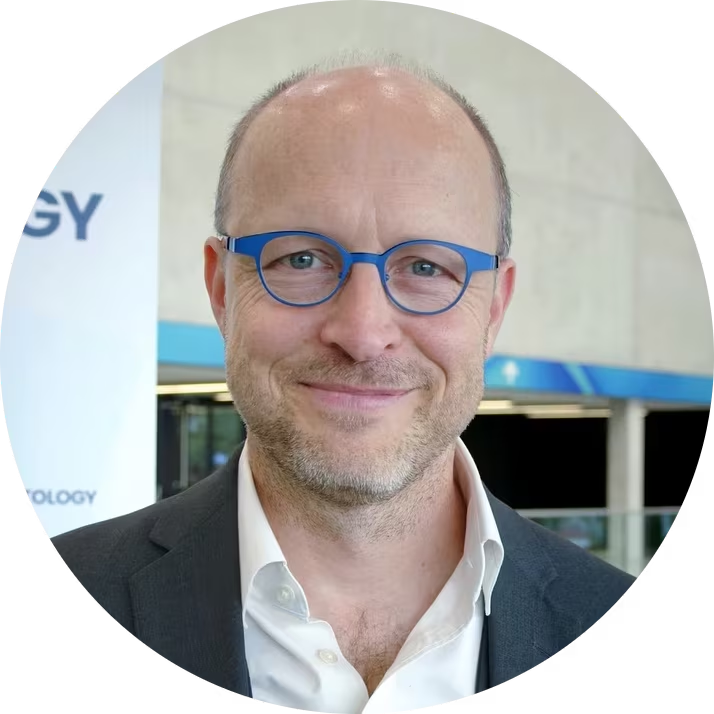
New data from A-STAR offer real-world insights into systemic treatment use in atopic eczema, including drug survival and treatment patterns in older adults. Prof. Carsten Flohr also discusses how the register could evolve to support research, clinical decision-making, and greater patient involvement.

There was no shortage of activity in the inflammatory and autoimmune dermatology space at AAD 2026. To capture some of the most important advances, we spoke with Dr Raj Chovatiya, who highlights the key themes, data readouts and emerging therapies that stood out across several major disease areas.

At the recent ILDS World Skin Summit, dermatology leaders from across the globe came together to discuss the evolving role of skin health in global medicine. In this interview, Prof. Olivier Gaide explores what sets the meeting apart from traditional scientific congresses and reflects on the key highlights from this year’s summit.

As 2025 draws to a close, it is clear that the past year has brought notable shifts across dermatology. To reflect on the developments that stood out most, members of our editorial board and recipients of our 2025 Future Leaders in Dermatology award share their perspectives, drawing on experience across subspecialties, regions and stages of career.

The 2025 European Academy of Dermatology and Venereology (EADV) Congress brought over 20,000 delegates to Paris this September, showcasing the latest advances in the field. With more than 180 sessions and 600 expert speakers, the meeting highlighted innovations ranging from new biologics and novel agents to real-world evidence and patient-centred care. In this article, we share key highlights from the congress, spotlighting the breakthroughs and clinical insights set to shape the future of dermatology practice.

Remibrutinib is a recently approved oral Bruton’s tyrosine kinase (BTK) inhibitor for CSU that has shown superior efficacy over placebo and a favourable safety profile in the pivotal phase 3 REMIX-1 (NCT05030311) and REMIX-2 (NCT05032157) trials. By inhibiting BTK, a central mediator of B-cell signalling and autoantibody production, remibrutinib may not only provide symptom relief and improves quality of life for patients with CSU, but could potentially modify the underlying disease mechanisms in autoantibody-positive patients and influence the long-term course of the condition. At the EADV Congress 2025, we had the pleasure of speaking with Prof. Martin Metz (Berlin, Germany), who presented new data on the immunomodulatory effects of remibrutinib. In our interview, Prof. Metz discusses the latest insights, explores how these findings could shape future clinical practice and reflects on the key questions that remain as research in this area continues to evolve.

Roflumilast 0.3% foam, a highly potent PDE4 inhibitor, represents a major advance in the management of seborrhoeic dermatitis. Approved by the FDA in 2023 following the phase 3 STRATUM trial, the once-daily, non-steroidal foam demonstrated significant improvements in signs and symptoms of the disease. At the EADV Congress 2025, Dr Raj Chovatiya presented new subgroup data showing the treatment’s consistent efficacy and tolerability across diverse skin and hair types.

Amlitelimab, a novel OX40 Ligand-targeting antibody, shows promise in inducing long-lasting remission in atopic dermatitis. The Phase 2b STREAM-AD trial explored how patients respond after treatment withdrawal, revealing that many maintain clear skin months later. Dr Andrew Blauvelt discusses the study’s design, safety profile, and the potential for this therapy to offer durable disease control. 2

ORKA-001, a next-generation IL-23 inhibitor, is aiming to redefine psoriasis treatment. In the Phase 2a EVERLAST-A trial, this novel therapy is exploring high “knockout” doses and an extended half-life to achieve long-lasting clearance with fewer injections. Dr. Andrew Blauvelt shares insights on the study’s design, goals, and its potential to push treatment outcomes even further.

PsABIOnd is an ongoing observational study generating real-world evidence on the use of biologic therapies in psoriatic arthritis (PsA). As treatment options have expanded to include agents targeting TNF, IL-17 and IL-23, personalised care has improved, but direct comparative data remain limited. PsABIOnd addresses this gap by tracking treatment persistence, clinical outcomes and patient-reported experiences in patients initiating guselkumab (an IL-23 inhibitor) or an IL-17 inhibitor.

Dermatologists play a vital role in creating safe, inclusive spaces for LGBTQIA+ patients. In this interview, Assistant Professor Teerapong Rattananukrom explores why inclusive language matters, the unique skin challenges faced by transgender individuals, and how greater representation in research can help shape more equitable, compassionate care.

Ultra-high frequency ultrasound is emerging as a valuable tool in the management of alopecia areata (AA). Beyond its established role in visualising hair follicle and scalp structures, it is now being explored for diagnosing AA, distinguishing it from other types of hair loss, and monitoring disease progression across different stages. Crucially, this non-invasive imaging technique also shows promise in predicting and tracking treatment responses, paving the way for more personalised care strategies for patients receiving targeted therapies.

Each year, the EADV offers a funded EADV Clinical Fellowship & Research Fellowship programme designed to provide additional opportunities and support for young dermatologists, trainees and junior scientists. These initiatives aim to help individuals gain hands-on experience, expand their skills and broaden their knowledge of dermatology and venereology in leading European centres. However, it can sometimes be difficult to know exactly what these opportunities involve, or whether they are the right fit for you. To help answer that question, there is no better way than to hear directly from someone with first-hand experience. This year, Dr Flavia Manzo Margiotta (University of Pisa, Italy) was awarded the EADV Clinical Fellowship, gaining valuable experience at Städtisches Klinikum Dessau under the expert guidance of Prof. Christos Zouboulis, Dr Georgios Nikolakis, and colleagues.

Drug-resistant fungal skin infections are an emerging global health concern, with cases increasingly reported across continents. These infections are more difficult-to-treat fungal, often require prolonged therapy, and are associated with higher rates of recurrence. To help address this growing problem, it is important to understand the factors driving resistance, explore potential solutions to limit the spread of these organisms and recognise the challenges involved in implementing effective control strategies. To explore some of these factors, we spoke with Dr Olufolakemi Cole-Adeife (Lagos, Nigeria), who presented her research on this topic ‘Recalcitrant Fungal Skin Infections and Possible Links with Topical Corticosteroid and Antiseptic Misuse in Nigeria: A Case Series’ at the EADV Congress 2025. In this discussion, Dr. Cole shares insights into her findings and the wider implications for clinical practice and public health.

 touchDERMATOLOGY
Register Now!
Explore the latest in medical education and stay current in your field. Create a free account to track your learning.
- Save your progress for video
- Keep track of your CME credits
- Add personalised learning notes
- Receive updates from course leaders and faculty
- Be the first to hear about new and exciting interactive learning opportunities
Log into your Touch Account
Keep track of your clinical interests and newsletter subscriptions.
Sign up with an Email
Or use a .
Register now for FREE access
Already registered? Login below.
