
TouchDERMATOLOGY coverage from EADV 2025:
Actinic keratosis (AK) is a common condition, affecting up to 25% of the adult population, particularly those over the age of 60. It presents as patches of dry, scaly skin caused by long-term sun exposure and, while usually low risk, can progress to squamous cell carcinoma.
Recent studies have identified the phosphoinositide 3-kinase (PI3K)/mechanistic target of rapamycin (mTOR) pathway as a significant driver of AK development and progression. Targeting this pathway, bimiralisib is an investigational pan-PI3K/mTOR inhibitor formulated as a topical treatment, designed to reduce AK lesion proliferation while minimising systemic adverse events.
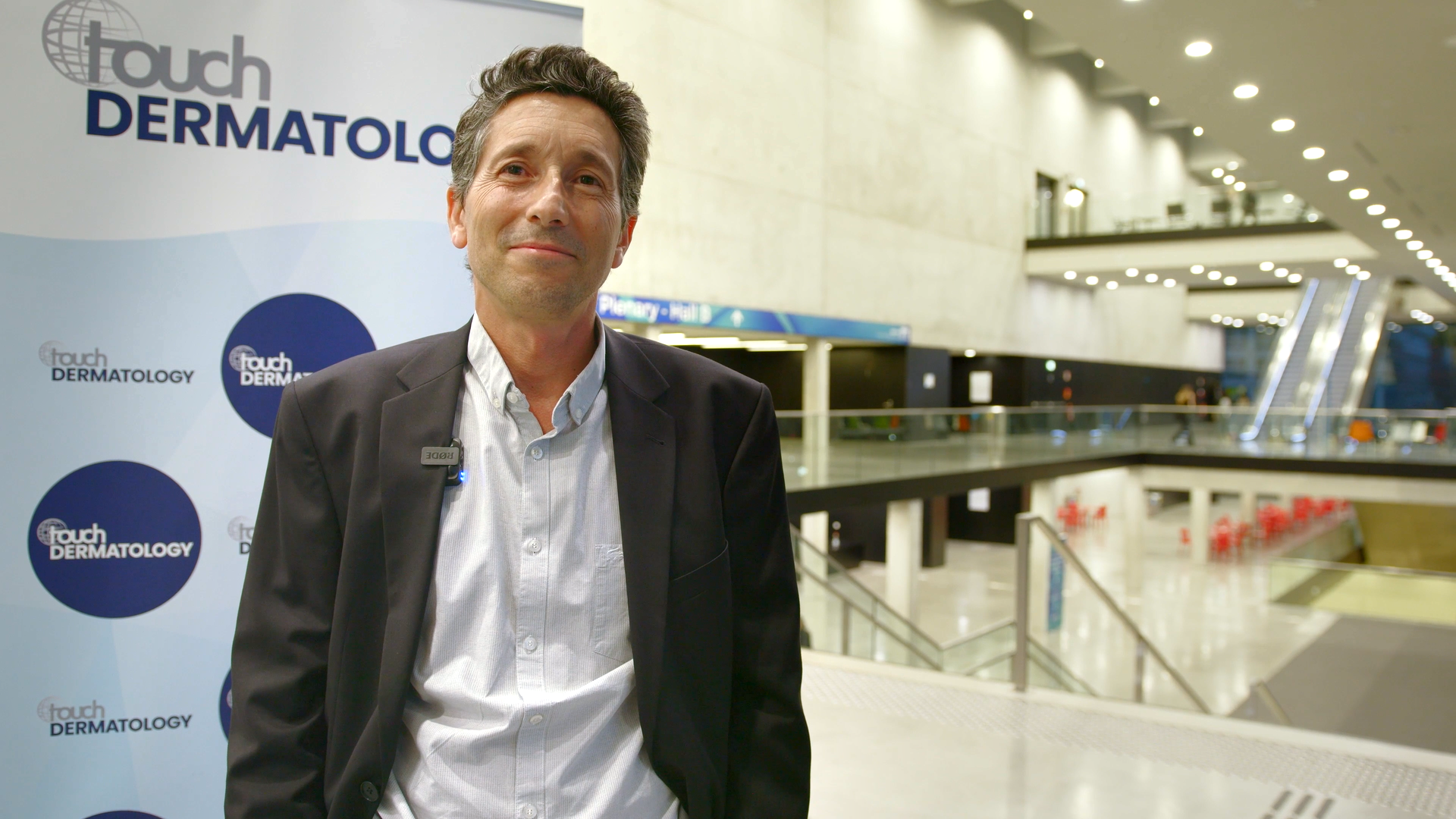
At the EADV Congress 2025 (Paris, France; 7–11 September), interim results from the ongoing randomized, proof-of-concept phase II trial (NCT06319794) investigating 2% bimiralisib gel for actinic keratosis were presented. In this interview, we spoke with Prof. Olivier Gaide (Lausanne University Hospital, Switzerland) to discuss the findings.
Q. Could you describe the risk factors associated with developing actinic keratosis and its presentation in patients?
The main risk factors for AK are age and exposure to UV light. Consequently, individuals most commonly develop lesions on sun-exposed areas, such as the back of the hands, face and for those who are bald, on the surface of the scalp.
Clinically, patients may present with either multiple or solitary zones of hyperkeratosis. In their thinner forms, these lesions are barely visible but easily palpable, whereas in more visible forms they are highly hyperkeratotic and can mimic squamous cell carcinoma.
Q. What risks are associated with leaving actinic keratosis untreated?
Actinic keratosis is a marker of sun exposure and therefore a risk factor for the development of several types of skin cancer, most notably squamous cell carcinoma, but also basal cell carcinoma and melanoma. However, at the level of an individual lesion, actinic keratosis carries the risk of progressing specifically to squamous cell carcinoma.
Q. How does bimiralisib gel exert its therapeutic effect in actinic keratosis?
Bimiralisib is an inhibitor of the PI3K/AKT/mTOR pathway. This pathway is highly upregulated in both actinic keratosis and squamous cell carcinoma. Bimiralisib inhibits AKT as well as mTORC1 and mTORC2, so bimiralisib has multi-level inhibitory activity. This broad mechanism of action formed the rationale for investigating bimiralisib as a treatment for actinic keratosis.
Q. Could you briefly outline the design and inclusion criteria of the phase II study?
We previously conducted a phase I safety trial with topical bimiralisib, together with data from preclinical animal studies, demonstrated a good safety profile.. Based on these findings, the current phase II study was designed as a dose-regimen finding clinical trial.
This phase II trial enrolled patients with grade 1 or 2 actinic keratosis on the face, scalp, or backs of the hands. Participants were randomised 1:1 into two arms to receive either a daily application of 2% bimiralisib gel for either 2 or 4 weeks, followed by a 4-week washout and efficacy assessment. Patients who achieved a significant reduction in lesions could then opt to enter an 8-week treatment extension.
Q. What were the main objectives of the study?
The primary objective of the study was to assess the proportion of patients achieving an Investigator’s Global Assessment (IGA) score of 0 or 1, corresponding to ‘total clearance’ or ‘partial clearance’ of the actinic keratosis. As this was a phase II study, an additional objective was to monitor the safety and tolerability profile of the drug and assess its potential systemic absorption into the bloodstream.
Q. What were the interim findings from the study?
Treatment-related adverse events observed in the study were primarily local reactions such as erythema, erosion, crusting, and itching. All events were mild, classified as grade 1 or grade 2, with no grade 3, 4, or 5 drug-related adverse events reported. In addition, no unrelated adverse events above grade 2 were observed. Overall, these findings indicate that the drug was considered safe in this study.
In terms of efficacy, the majority of patients achieved an IGA score of 0 or 1, corresponding to total or partial clearance. This is a strong result given the high proportion of patients with grade 2 actinic keratosis in the study. In conclusion, bimiralisib appears to be both safe and effective for the treatment of actinic keratosis.
About Prof. Olivier Gaide
Prof. Olivier Gaide is a dermatologist advancing the field through his expertise in skin cancer detection and innovative therapeutic approaches. Based at Lausanne University Hospital, he leads the Excellence Centre for Melanoma and skin cancer. His research focuses on non-invasive imaging for the early detection of skin cancer and the cutaneous effects of electromagnetic waves, including radiotherapy. Prof. Gaide has published more than 80 papers in leading journals such as Nature Immunology, Nature Medicine, and The Lancet.
Disclosures: Olivier Gaide discloses that Lausanne University Hospital received a grant from Torqur AG to conduct the clinical study. His salary is fully funded by Lausanne University Hospital (CHUV), and neither he or his immediate family members hold shares in any pharmaceutical companies. Fees for advisory boards, conferences and studies are collected by Lausanne University Hospital from Sanofi, Janssen-Cilag, Novartis, Roche, Almirall, Widmer, Galderma, L’Oréal, Takeda, Leo, Bristol Myers Squibb and Pierre Fabre. Dr Gaide has also received congress travel support from Pierre Fabre.
This content has been developed independently by Touch Medical Media for touchDERMATOLOGY. It is not affiliated with the European Academy of Dermatology and Venereology (EADV). Views expressed are the speaker’s own and do not necessarily reflect the views of Touch Medical Media.
Cite: Encouraging interim results for topical bimiralisib in actinic keratosis. touchDERMATOLOGY. September 24, 2025
Editors: Gina Furnival & Victoria Jones
More content in dermato-oncology.
Related content