TouchDERMATOLOGY coverage from EADV 2025:
Roflumilast 0.3% foam, a highly potent and selective phosphodiesterase-4 (PDE4) inhibitor, was approved by the US Food and Drug Administration (FDA) in July 2023 for the treatment of seborrhoeic dermatitis, based on efficacy and safety results from the phase 3 STRATUM trial, (NCT04091646).
Seborrhoeic dermatitis is a common, chronic inflammatory skin disorder that primarily affects sebaceous gland-rich areas such as the scalp, face and chest. Characterised by redness, scaling, itching and irritation, it typically follows a relapsing and remitting course. Presentation varies depending on the site, severity and skin type, with erythema and scaling often more prominent in lighter skin tones, while hyperpigmented or hypopigmented patches may occur in darker skin tones, sometimes complicating diagnosis.
Traditional treatment options, including antifungal agents, topical corticosteroids and calcineurin inhibitors, can help manage symptoms but are often limited by incomplete response, safety concerns with long-term use, poor tolerability and their inability to address underlying causes. Many formulations are also difficult to apply and may not work effectively across different hair types, posing additional challenges for treating scalp involvement where the condition frequently occurs.
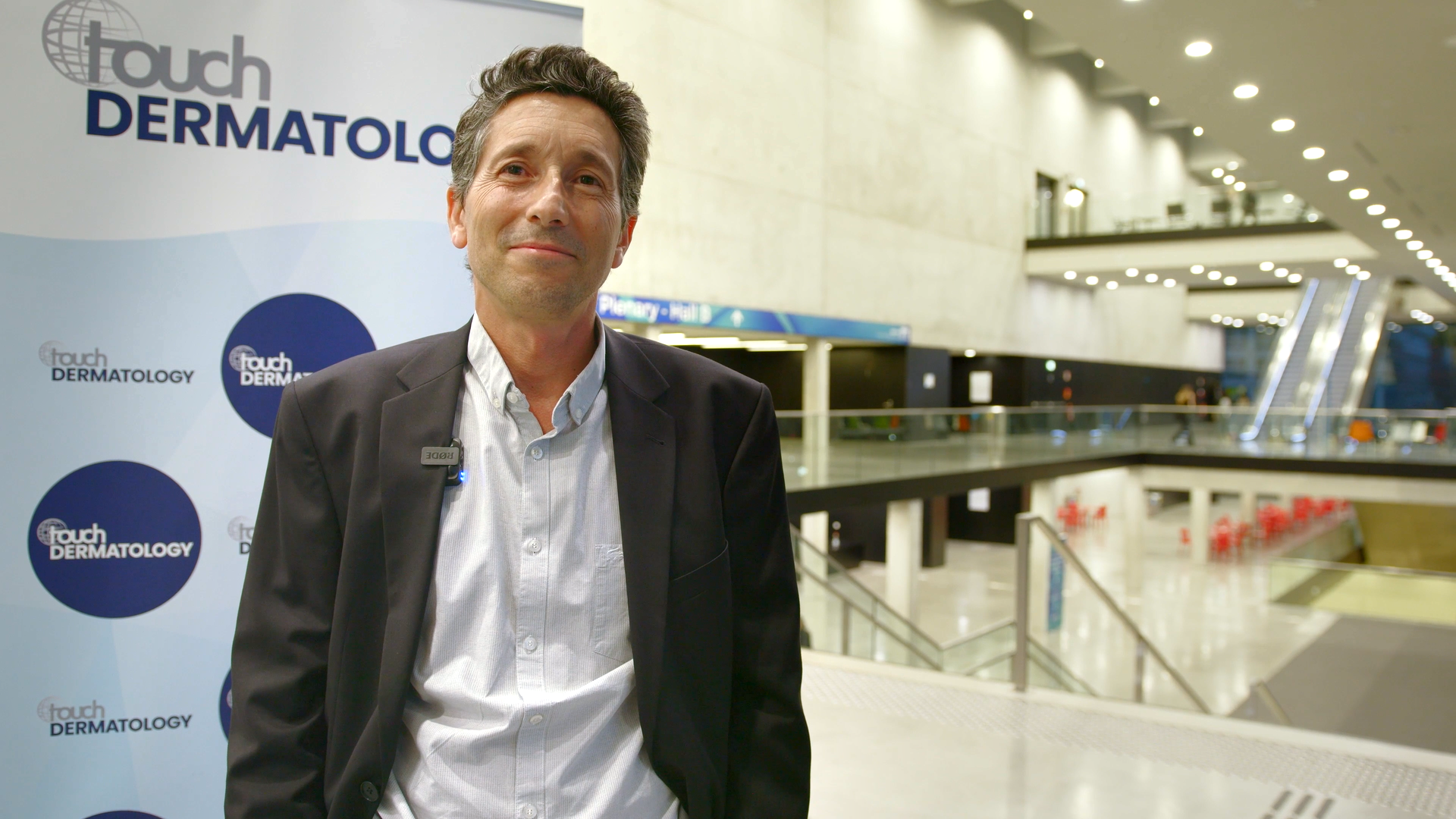
At the EADV Congress 2025 in Paris, France, our Expert Faculty member Dr Raj Chovatiya (Chicago, IL, USA) presented a subgroup analysis from STRATUM exploring how roflumilast foam performed across different skin and hair types. We were delighted to speak with him about the key findings and their potential clinical impact.
Questions
- Could you give us a brief overview of the phase 3 STRATUM trial?
- What was the rationale for conducting a subgroup analysis in patients with diverse skin types?
- What were the key findings from this analysis?
- What is the potential clinical impact of these results on managing seborrhoeic dermatitis?
Transcript:
Q. Could you give us a brief overview of the phase 3 STRATUM trial?
The STRATUM study was designed to specifically look at the effect of roflumilast 0.3% foam for the treatment of seborrheic dermatitis. There are a couple of points worth highlighting here.
First, how often do you see very large phase 3 clinical trial programmes for seborrhoeic dermatitis? Not often, and that’s one of the more unique aspects of this particular study.
Second, there has been little advancement in foams as a treatment vehicle, which is another distinctive feature of this trial. Given that seborrhoeic dermatitis frequently affects hair-bearing areas, often the scalp and facial skin, as well as other regions such as the chest and skin folds, the development of an effective foam formulation is particularly valuable.
STRATUM was a randomised, double-blind, placebo-controlled study designed to evaluate the foam vehicle itself, which incorporates many of the elements familiar from the roflumilast cream formulation. These include the absence of irritants, skin penetration enhancers, and the use of cosmetic-grade emulsifiers, combined with a high water-based content to make the product easy to apply. The investigational product (IP) group received roflumilast 0.3%. Roflumilast being a phosphodiesterase 4 inhibitor, one that has been approved for atopic dermatitis and psoriasis and seems to occupy an important role in a lot of T-cell mediated diseases.
In this study, individuals received daily treatment for 8 weeks. The primary goal was to evaluate outcomes in individuals who initially presented with moderate-to-severe forms of the disease, characterised primarily by redness (erythema) and scaling, and to assess how many achieved clear or almost clear skin by the end of the study period. Other outcomes were also tracked, but this was the main focus of the trial.
Q. What was the rationale for conducting a subgroup analysis in patients with diverse skin types?
The STRATUM study met its primary endpoint, and it’s worth emphasising that around 80% of participants achieved clear or almost clear skin by week 8, which is actually a very, very high rate across really any disease state, highlighting the therapy’s effectiveness.
An important question that followed was how seborrhoeic dermatitis, which affects people across all skin types, manifests and responds to treatment in individuals with darker skin tones. In these patients, the condition can present with hyperpigmentation (dark patches) or hypopigmentation (lighter areas), both of which may result directly from inflammation or as post-inflammatory changes that persist after the rash clears.
What we wanted to understand was whether the improvement in skin signs and symptoms was consistent across all skin types. This was assessed using several metrics, including race, ethnicity and Fitzpatrick skin phototype. In addition, among individuals with hyperpigmented or hypopigmented areas, we aimed to determine whether there was improvement and normalization of these features over the course of treatment.
Q. What were the key findings from this analysis?
By and large, the efficacy of roflumilast was consistent across all the different patient subgroups analysed. Normally, you parse out patients into smaller groups, particularly by race and ethnicity, the sample sizes can become quite small. However, the numerical trends observed suggested there were no meaningful differences in treatment response, which is expected given that race and ethnicity are largely social variables as opposed to one that’s truly biological.
From a skin phototyping standpoint, there was also little difference observed. Fitzpatrick skin type is sometimes used as a proxy for pigmentation — it’s not a perfect measure, but it is often used as a stand-in to help differentiate between lighter and darker skin tones.
Additionally, what I think is the most important findings was observed in patients who were tracked for hypo- or hyperpigmentation. This was a variable that was built into the trial itself, something that has not been done before in seborrhoeic dermatitis trials. Notably, these individuals largely achieved normal-looking skin by the end of the treatment period.
This suggests there may be both direct and indirect effects of roflumilast at play. The literature describes a potential role for phosphodiesterase-4 in pigment production, indicating a possible direct mechanism. Indirectly, as we help to treat the inflammation of the disease, post inflammatory pigmentary alteration has time to improve and normalize as well.
Q. What is the potential clinical impact of these results on managing seborrhoeic dermatitis?
These results, along with the primary results, as well as other important data, show that roflumilast foam is highly tolerated across diverse hair types in addition to skin types. This includes textured hair, kinky-coiled hair, straight hair, hair that has chemical products in it, hair that’s dyed, and hair that’s straightened or pressed. All of these individuals found the product to be highly tolerable.
This is relevant because across different cultural groups, there may be different hair care practices, and across different groups, based on other variables, there may also be different biological forms of hair. The foam is not only highly tolerated and well-received in these groups, but the efficacy is consistent as well — suggesting that no matter who you are, as long as you fall within the population studied, this would be an effective choice for seborrhoeic dermatitis.
The bigger point is that for anyone who might be concerned about how this stacks up against traditional therapies — usually antifungals and topical corticosteroids — most of those treatments are limited either by tolerability and irritancy, or by the fact that they cannot be used for very long and must be applied intermittently. They are also often not well tolerated from a topical standpoint, as they tend to be greasy, clunky and difficult to apply in hair-bearing areas.
These data show that this is truly a head-to-toe treatment for seborrhoeic dermatitis that not only addresses the direct signs of the disease but also helps resolve some of the sequelae that may be left behind, particularly in individuals with darker-toned skin.
About Dr Raj Chovatiya
Dr Raj Chovatiya is Clinical Associate Professor of Medicine at Rosalind Franklin University Chicago Medical School and Founder and Director of the Center for Medical Dermatology Immunology Research in Chicago, Illinois. His clinical and research focus includes the intersection of cutaneous immunology and inflammatory disease. He received his MD and PhD in immunology from Yale and completed his residency, postdoctoral research fellowship, and MS in Clinical Investigation at Northwestern University where he also served as Chief Resident. Dr. Chovatiya has a particular interest in optimizing patient-centered care, understanding chronic disease burden especially in understudied inflammatory diseases, exploring health and social disparities, and improving care across diverse skin types. He has published numerous abstracts and manuscripts and has been nationally and internationally recognized for his contributions as a clinician, educator, researcher, and leader
Disclosures: Dr Raj Chovatiya has served as a consultant for AbbVie, Acelyrin, Alumis, Amgen, AnaptysBio, Apogee Therapeutics, Arcutis Biotherapeutics, Argenx, Astria Therapeutics, Avalere Health, Beiersdorf, Boehringer Ingelheim, Bristol Myers Squibb, Cara Therapeutics, Castle Biosciences, Celldex Therapeutics, CLn Skin Care, Dermavant, Eli Lilly and Company, EMD Serono, Formation Bio, Forte Biosciences, Galderma, Genentech, GSK, Incyte, Inmagene Bio Inc., Johnson & Johnson, Kenvue, Kowa Pharmaceuticals America, LEO Pharma, L’Oréal, Nektar Therapeutics, Nia Health, Novartis, Opsidio, Organon, Pfizer, RAPT, Regeneron, Sanofi, Sitryx, Takeda, TRex Bio, UCB and Zai Lab.
This content has been developed independently by Touch Medical Media for touchDERMATOLOGY. It is not affiliated with the European Academy of Dermatology and Venereology (EADV). Views expressed are the speaker’s own and do not necessarily reflect the views of Touch Medical Media.
Cite: Roflumilast foam 0.3% proves highly effective at controlling seborrheic dermatitis across diverse skin and hair types. October XX, 2025
Editors: Gina Furnival.
More content in dermatitis.
Related content
What roflumilast 0.3% foam brings to your psoriasis clinical toolkit
Amlitelimab: A step toward last remission in atopic dermatitis super-responders?
Latest updates in atopic dermatitis treatment and research, across all ages