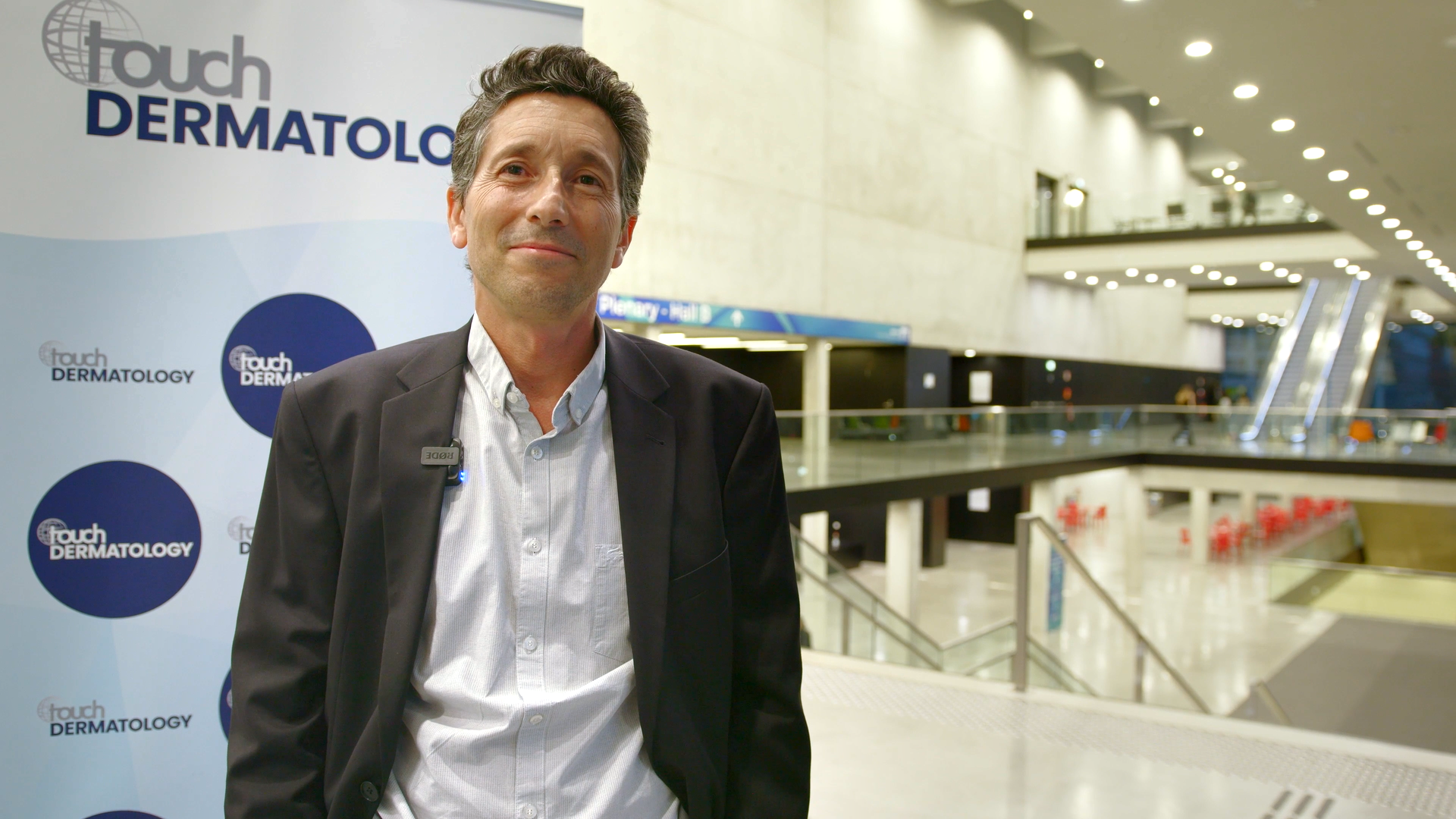
Dr Raj Chovatiya discusses highlights in atopic dermatitis, psoriasis, hidradenitis suppurativa and vitiligo from AAD 2026
 There was no shortage of activity in the inflammatory and autoimmune dermatology space at the 2026 American Academy of Dermatology (AAD) Annual Meeting in Denver, with new data across several disease areas that continue to evolve rapidly in both research and clinical practice.
To capture some of the key developments presented at the meeting, we spoke with Dr Raj Chovatiya (Chicago, IL, USA) who highlighted some of the main themes and agents generating interest at AAD 2026.
Key advances included OX40 ligand blockade, STAT6-targeting oral therapies, roflumilast and rezpegaldesleukin in atopic dermatitis; abrocitinib in chronic hand eczema; envudeucitinib and zasocitinib in psoriasis; upadacitinib and IL-15-directed approaches in vitiligo; and povorcitinib and sonelokimab in hidradenitis suppurativa.
TouchDERMATOLOGY coverage from AAD 2026:

My name is Dr Raj Chovatiya. I’m an Associate Professor at the Roslyn Franklin University of Medicine and Science Chicago Medical School and Founder and Director of the Center for Medical Dermatology and Immunology Research in Chicago, Illinois. I’m also the Editor-in-chief of TouchREVIEWS in Dermatology.
AAD Denver 2026 was as exciting as one could imagine, based on how much new data we saw in many of the disease states that many of us see on a day-to-day basis, but for which we have historically had very, very limited options. Personally, as someone who spends a lot of time thinking about immunology from a research, clinical care and educational standpoint, there was a lot happening in atopic dermatitis, psoriasis, hidradenitis suppurativa, and even alopecia areata and vitiligo that is really going to make us think about how we might change our practice in the future.
Atopic dermatitis
Let me touch on atopic dermatitis first and highlight some of the exciting developments in this space. We saw some new data presented on the OX40 class, particularly in the case of OX40 ligand blockade. I think there has been a lot of debate about whether or not this is going to be a therapeutic class that elevates expectations for efficacy, versus having certain trade-offs that we have seen with some other agents in the class in relation to safety. The bottom line is that it looks like there is efficacy to be had here, and I think the story of long-term potential and infrequent dosing is going to be very important as this moves forward. I remain optimistic about the role some of our new therapies might play here.
Additionally, we saw some new oral molecules, particularly those targeting STAT6, which are highly selective and very much in line with the way we think about some of our type 2 inflammatory blockers in the world of atopic dermatitis. I am very curious to see where this is going to go in the future.
We also had a chance to see some very interesting topical data, particularly in the case of roflumilast, a PDE4 inhibitor, in infants aged three months to less than 24 months, a group that otherwise does not get included in many studies. There were a few interesting nuances to this study design that really suggest we may potentially have a new nonsteroidal option in this very important age group, where safety and tolerability perhaps rank above everything else. There have also been some very interesting immunology-based approaches, really trying to answer this question in a different way.
Of course, I will bring up REZPEG, or rezpegaldesleukin, which showed some data in poster format in atopic dermatitis and highlighted how IL-2 expansion of Tregs can potentially affect immune resolution. This is a very different way of thinking about immune activity and may potentially have longer-lasting effects in terms of long-term outcomes. We also saw some data in alopecia areata suggesting that this might be a mechanism we think about more broadly across a range of different disease states.
Chronic hand eczema
When thinking about some of the related areas alongside atopic dermatitis, chronic hand eczema has been a particularly hot topic. We have seen a lot of analyzes of delgocitinib over the last couple of years. There was also a very nice late-breaking abstract presented here on the role of abrocitinib in chronic hand eczema, potentially outlining a role for this oral JAK inhibitor in helping individuals with very chronic and burdensome hand disease.
Psoriasis
I do not want to forget some of the other disease states in which we have seen very interesting readouts. I will start with psoriasis, where we saw data from oral TYK2 molecules, in the case of envudeucitinib as well as zasocitinib, two distinct but similar blockers of TYK2 activity that suggest our oral treatment space is going to get very crowded and may offer us a chance to elevate expectations for what we can achieve with oral therapy for our patients.
Vitiligo
Vitiligo also had some very interesting readouts. Upadacitinib had its Phase 3 readout from the Viti-UP studies, suggesting that we may have an oral JAK inhibitor coming our way when thinking about how we might treat patients for whom topicals are just too difficult because of very extensive disease.
We also saw some fascinating data looking at IL-15, or dusikinib, which depletes cytotoxic CD8 T cells, and really asking whether this type of approach, particularly in combination with phototherapy, could help our patients with vitiligo.
Hidradenitis suppurativa
We saw some hidradenitis suppurativa data in the case of povorcitinib and sonelokimab, the JAK inhibitor and then an IL-17A/F-optimised nanobody-type technology that can bind to albumin and be delivered into sites quite efficiently based on local inflammation. Both showed long-term data suggesting that there may be gains in efficacy for patients treated with these therapies over a longer period.
Psoriatic arthritis
Finally, I will touch on some of the headline data from the psoriatic arthritis study that looked at ixekizumab and tirzepatide, trying to understand the role of our GLP-1 molecules alongside some of our traditional therapies and how we might be able to improve overall outcomes for our patients.
The bottom line is that this was a very exciting AAD. I cannot wait to see what this year brings by the time we get through the summer and get to EADV, and I am happy to go on that ride with you.
About Dr Raj Chovatiya
Dr Raj Chovatiya is Clinical Associate Professor of Medicine at Rosalind Franklin University Chicago Medical School and Founder and Director of the Center for Medical Dermatology Immunology Research in Chicago, Illinois. His clinical and research focus includes the intersection of cutaneous immunology and inflammatory disease. He received his MD and PhD in immunology from Yale and completed his residency, postdoctoral research fellowship, and MS in Clinical Investigation at Northwestern University where he also served as Chief Resident. Dr. Chovatiya has a particular interest in optimizing patient-centered care, understanding chronic disease burden especially in understudied inflammatory diseases, exploring health and social disparities, and improving care across diverse skin types. He has published numerous abstracts and manuscripts and has been nationally and internationally recognized for his contributions as a clinician, educator, researcher, and leader
Disclosures: Dr Raj Chovatiya has served as a consultant for AbbVie, Acelyrin, Alumis, Amgen, AnaptysBio, Apogee Therapeutics, Arcutis Biotherapeutics, Argenx, Astria Therapeutics, Avalere Health, Beiersdorf, Boehringer Ingelheim, Bristol Myers Squibb, Cara Therapeutics, Castle Biosciences, Celldex Therapeutics, CLn Skin Care, Dermavant, Eli Lilly and Company, EMD Serono, Formation Bio, Forte Biosciences, Galderma, Genentech, GSK, Incyte, Inmagene Bio Inc., Johnson & Johnson, Kenvue, Kowa Pharmaceuticals America, LEO Pharma, L’Oréal, Nektar Therapeutics, Nia Health, Novartis, Opsidio, Organon, Pfizer, RAPT, Regeneron, Sanofi, Sitryx, Takeda, TRex Bio, UCB and Zai Lab.
This content has been developed independently by Touch Medical Media for touchDERMATOLOGY. It is not affiliated with the American Academy of Dermatology (AAD). Views expressed are the speaker’s own and do not necessarily reflect the views of Touch Medical Media.
Cite: AAD 2026 key updates in inflammatory and autoimmune diseases. TouchDERMATOLOGY. 15 April, 2026
Editors: Gina Furnival.
More content in Inflammatory & Autoimmune diseases
SIGN UP to TouchDERMATOLOGY!
Join our global community today for access to thousands of peer-reviewed articles, expert insights, and learn-on-the-go education across 150+ specialties, plus concise email updates and newsletters so you never miss out.