
TouchDERMATOLOGY coverage from EADV 2025:
Over the past decade, treatment options for psoriatic arthritis (PsA) have expanded considerably, with multiple biologic therapies now targeting different inflammatory pathways, including TNF, IL-17, and IL-23. While this therapeutic diversity allows for more personalised treatment decisions, it also poses challenges, as direct head-to-head evidence between many agents is lacking.
PsABIOnd (NCT05049798) is an observational study designed to address this need. It is collecting real-world data on patients with PsA initiating guselkumab (an IL-23 inhibitor) or an IL-17 inhibitor, assessing treatment maintenance, clinical outcomes and patient-reported experiences over time.
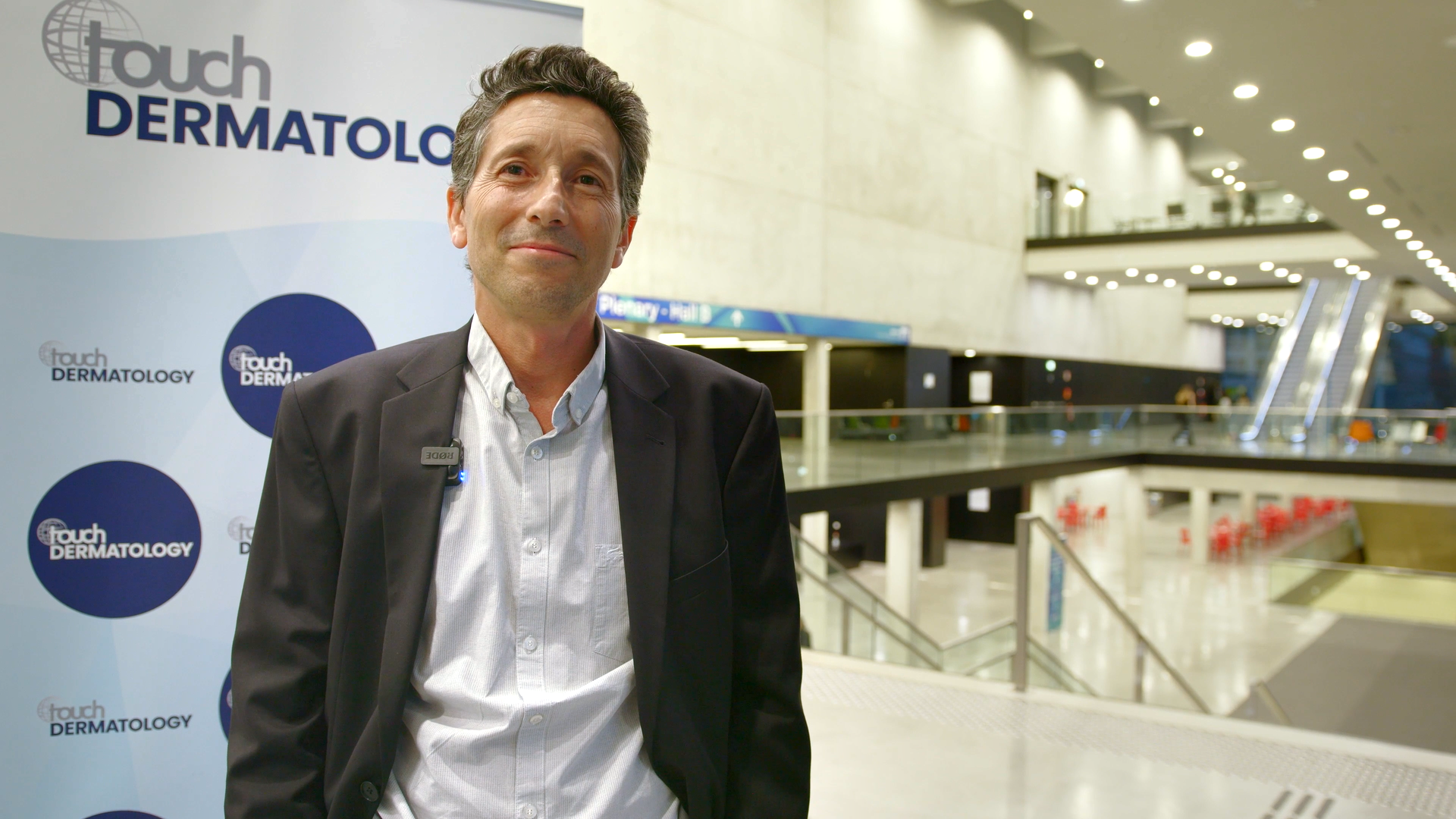
To explore the latest results, I spoke with Prof. Laure Gossec (Paris, France) following her oral presentation, “Patient Reported Impact and Satisfaction With Guselkumab and IL-17 Inhibitors in Psoriatic Arthritis: 12-month Results of the PsABIOnd Observational Study,” at the European Academy of Dermatology and Venereology (EADV) Congress 2025, held in Paris from 17–21 September.
Q. Why is it so important that we investigate real-world data for psoriatic arthritis?
We now have a wide range of treatment options for PsA, but unlike psoriasis, where many head-to-head trials have enabled us to classify therapies by efficacy, such head-to-head trial data is lacking in PsA.
Currently, head-to-head studies exist only for comparing IL-17 inhibitors to TNF inhibitors, and we have no other head-to-head trials to let us know which drugs work better. As a result, current recommendations state that all approved biologic drugs for PsA are effective. This means that clinicians can choose whichever they feel is best for their patient. Real-world data are therefore essential to better understand how treatments perform outside of a trial setting. They can also help us explore whether there are any differences between different modes of action.
Q. What were the objectives and study design of PsABIOnd?
PsABIOnd (NCT05049798) is a large, international observational real-world study collecting data on patients with PsA who are initiating guselkumab or an IL-17 inhibitor as a first, second, third or fourth line PsA biologic therapy.
The primary outcome of PsABIOnd was to look at treatment maintenance over three years with guselkumab, an IL-23 inhibitor, versus one of the IL-17 inhibitors, with participants being regularly monitored every 6 months. This study was sponsored and organised by Johnson & Johnson, the developer of guselkumab.
Q. What were the key findings from the one-year analysis of PsABIOnd?
A total of 1,300 patients were included in PsABIOnd, with one-year results currently available for approximately 1,000 study participants.
There were some notable differences in baseline characteristics amongst those included in the study. Individuals receiving the IL-23 inhibitor, guselkumab, were more often receiving the treatment as a fourth line biologic therapy. They also tended to have more extensive skin psoriasis and a higher burden of comorbidities, particularly obesity. So these patients could be considered a bit more difficult-to-treat.
The main finding was that, after one year of treatment, maintenance rates were very similar between IL-17 inhibitors and guselkumab, with approximately 80–83% of patients remaining on therapy over the one year of follow-up.
From this, two key points emerge. One, most patients continue on their drug when receiving one of these non-TNF biologic therapies. Two, treatment maintenance is very similar between an IL-17 inhibitor and an IL-23 inhibitor, which in this case is guselkumab.
Despite baseline differences, the one-year results also showed that guselkumab performed as well as the IL-17 inhibitors. After adjusting for baseline differences (since this is not a randomized trial) using propensity score analysis, no differences in efficacy were observed between the two groups. Using and assessing composite scores that assess joints, patient-reported outcomes, enthesitis, and skin, we found that outcomes were very similar between the IL-17 inhibitors and guselkumab.
At the EADV 2025 oral presentation session, we presented part of our one-year results, specifically focusing on patient-reported outcomes and how patients feel during treatment. From previous studies, we know that patients with PsA prioritise three main aspects of their disease: pain, skin involvement; and fatigue.
With both guselkumab and IL-17 inhibitors, patients reported significant improvements over one year. Pain improved a lot, and skin symptoms showed substantial improvement, with a marked reduction in their impact on daily life as measured by patient-reported outcomes. Fatigue also improved, although to a lesser extent, likely due to its multifactorial nature. Once again, the improvements were very similar between the two treatment groups.
Q. What conclusions can we draw in relation to treatment with guselkumab or an IL-17 inhibitor?
Firstly, these data indicate that we have several effective treatment options, all showing good maintenance. A one-year maintenance rate of around 80% is good, particularly in these patients, many of whom had failed previous therapies and were receiving these drugs as second- to fourth-line options.
Secondly, these findings confirm the efficacy of both drugs in a real-world setting, which is particularly important given the previous lack of real-world data for these therapies.
And thirdly, these results support the current recommendations, which say that clinicians can choose between an IL-17 or an IL-23 inhibitor when considering the overall clinical picture of the patient. This confirms that, at present, we cannot put an order between these drugs.
In conclusion, I look forward to seeing the longer-term outcomes, but for now, these findings confirm that we have several highly effective treatment options available.
About Prof. Laure Gossec
Prof. Laure Gossec is Professor of Rheumatology at Sorbonne Université and Pitié-Salpêtrière Hospital in Paris, France, where she divides her time between clinical practice, research and teaching. Her current research focuses on patient-centred outcomes, prediction of treatment response, and the use of e-health and artificial intelligence in rheumatology, particularly in psoriatic arthritis, rheumatoid arthritis, and spondyloarthritis.
Disclosures: Prof. Laure Gossec has received consulting fees from AbbVie, AlfaSigma, Amgen, Bristol Myers Squibb (BMS), Celltrion, Johnson & Johnson, Lilly, Moonlake, Novartis, Pfizer, Stada, and UCB. She has also received research grants from AbbVie, Lilly, Novartis, and UCB.
This content has been developed independently by Touch Medical Media for touchDERMATOLOGY. It is not affiliated with the European Academy of Dermatology and Venereology (EADV). Views expressed are the speaker’s own and do not necessarily reflect the views of Touch Medical Media.
Cite: PsABIOnd: New 12-month real-world data comparing IL-17 inhibitors and guselkumab in psoriatic arthritis. TouchDERMATOLOGY. October 06, 2025
Editors: Gina Furnival.
More content in psoriasis.
Related content
- What roflumilast 0.3% foam brings to your psoriasis clinical toolkit
- Latest insights in atopic dermatitis and research, across all ages
- First-in-class, oral peptide, icotrokinra show superior efficacy in ICONIC-ADVANCE trials for plaque psoriasis