TouchDERMATOLOGY coverage from EADV 2025:
Laser and energy based devices are transforming dermatology, offering increasingly advanced ways to treat a wide range of conditions from pigment disorders and tattoo removal to skin rejuvenation and aesthetic enhancement. As the technology evolves, so too does our understanding of how to use it most effectively in clinical practice. However, at the same time, the field faces significant challenges, including the influence of marketing and the need for patient education.
Organizations such as the European Society for Lasers and Energy Based Devices (ESLD) and the EADV Task Force for Laser Dermatology and Energy Based Devices play a crucial role in addressing these issues through education, evidence based guidance and collaboration with the wider dermatology community.
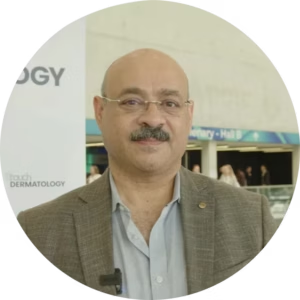
To explore the latest developments, ongoing challenges and future priorities in this field, we spoke with our Expert Faculty member, Prof. Ashraf Badawi (Cairo, Egypt), President of the ESLD and Chair of the EADV Task Force for Laser Dermatology and Energy Based Devices.
Q. What are the latest advances in laser and energy based devices?
Every year I am asked this question, and every year the answer is different!
This year, I think we have realised that the latest advances are not about new technological developments. Rather, they are advances in our understanding of the technologies available and the science behind them.
We are now in a much better position to clearly distinguish between what we know is based on marketing and what is based on science. Technologies driven purely by marketing are likely to vanish within a couple of years, whereas those that are based on solid science are the ones we will continue to use for many years to come.
For example, a few years ago the star was the picosecond lasers, and everyone was talking about them. They were marketed and positioned as if it were the magical solution for all pigmentary disorders, tattoo removal treatments, and so on. After a while we discovered that although they do deliver faster results than previous Q-switched lasers, they are not a magic wand.
Moving forward, with a better understanding of the science behind the technologies available and the problems we are trying to treat, we are now in a better position to select patients appropriately and set the right expectations. So, if you ask me about the latest advances, I would say there is nothing particularly unique, but we now have a deeper understanding of the technologies we use, which enables us to choose the most appropriate option for each patient according to the problem we are aiming to address.
Q. What are the main challenges in laser and energy based practice, and how can we overcome these?
I think the biggest challenge is the expectations of our patients and their perceptions.
Ninety percent of people, when they undergo an aesthetic procedure, want quick results — they want to see the outcome before they leave the clinic. However, when we are working with lasers and energy based devices, in most cases it is a gradual process to achieve results.
This becomes a challenge because, when you explain this to patients, they often prefer to opt for injectables, as these provide much faster results. However, using lasers and energy based devices is a more effective way to achieve lasting results, because with these treatments we are able to improve both the structure and function of the skin. With most injectables, there is only a temporary improvement in how the skin looks, as these treatments are not slowing down the process of skin ageing, nor are they stimulating the restoration of the skin’s function. That is why, in many cases, when we use injectables, the endpoint can be worse than the starting point, because the ageing process continues and changes occur within the tissue. However, when we use lasers and energy based devices in the right way, we are able to restore the structure and function of the different layers of the skin, so that although our patients get older, their skin looks younger.
So there is an element of patient education involved in addressing this challenge. If a physician or practitioner does not take the time to explain to their patients what to expect, those patients can lose interest. As a result, even if they attend one session, they might not return for a second because they were expecting something more from the treatment. This is a challenge we need to address, we need to talk with our patients and we need to set the right expectations.
Q. Why is the work of the European Society for Lasers and Energy Based Devices (ESLD) so important in advancing the use of laser and energy based devices?
The ESLD is a non-profit organisation dedicated to education in the field of lasers and energy based devices. To me, the mission of the society is extremely important. As I mentioned earlier, this field is heavily influenced by marketing, and many technologies, including lasers, energy based devices and even injectables are advancing primarily due to market forces rather than the science behind them. The ESLD conducts a wide range of educational activities for practitioners in this field, which I believe is crucial. As a non-profit society, we focus on disseminating sound, evidence based science. We are not biased towards any particular technology, nor are we promoting specific products, our mission is simply to educate practitioners as well as the public.
Even the public sometimes rush into clinics and request certain procedures based on marketing, and in many cases those clinics then purchase the technology simply to meet patient demand. This is why we need to educate the public about what is right and what is wrong, what they should expect, and which devices may initially improve the skin but, in the long run, can cause complications such as fibrosis within the skin.
When we improve the understanding of both the public and practitioners in selecting the most appropriate technologies and procedures, it will lead to better outcomes for patients and greater overall satisfaction.
Q. How does ESLD’s presence at EADV align with the society’s goal to promote laser and energy based device medicine?
The ESLD is hosting a session during the EADV Congress, where we aim to raise key questions, address concerns, and discuss the main challenges in the field. This approach helps both the EADV community and the wider dermatology community stay aligned with current developments in the market and better understand the challenges we have been working to overcome in recent years.
In addition to that, we have meetings scheduled with the EADV board to discuss future congresses and the topics to be addressed. We are also working through the EADV Task Force for Laser and Energy Based Devices to publish position statements that help clarify some of the uncertainties in the field. All of this goes hand in hand with the goals of both the EADV and the ESLD.
Q. What are the key priorities and future plans of the EADV Task Force for Laser Dermatology and Energy Based Devices?
Recently, the EADV Task Force for Laser Dermatology and Energy Based Devices underwent a leadership change, with myself appointed as chair, alongside Dr Hans-Joachim Laubach and Dr Albert Wolkerstorfer as co-chairs. With this new structure and several new members joining the task force, we are working closely with the EADV management to design highly effective laser and energy device sessions for upcoming meetings. We are also developing dedicated courses for residents to help them gain a stronger understanding of the fundamentals of lasers and devices, which will enable them to better navigate this field. This will undoubtedly be reflected in improved performance and outcomes in clinical practice.
About Prof. Ashraf Badawi
Prof. Ashraf Badawi is currently President of the European Society for Lasers and energy based Devices (ESLD), Past President of the European Society for Cosmetic and Aesthetic Dermatology (ESCAD) and Co-Chair of the laser task force of the EADV. He is also a Professor of Dermatology at the National Institute of Laser Enhanced Sciences, Cairo University, Egypt, and Visiting Professor of Dermatology and Laser applications, Szeged University, Hungary.
Disclosures: Prof. Ashraf Badawi has nothing to disclose in relation to this interview.
This content has been developed independently by Touch Medical Media for touchDERMATOLOGY. It is not affiliated with the European Academy of Dermatology and Venereology (EADV). Views expressed are the speaker’s own and do not necessarily reflect the views of Touch Medical Media.
Cite: Beyond technology: How can we address the new challenges in laser and energy based dermatology? TouchDERMATOLOGY. October 1 2025
Editors: Gina Furnival & Victoria Jones
More content in aesthetic dermatology.
Related content
Register now to receive the touchDERMATOLOGY newsletter!
Don’t miss out on hearing about our latest articles, expert opinions, conference news, podcasts and more.