TouchDERMATOLOGY coverage from EADV 2025:
Skin neglected tropical diseases (NTDs), such as leprosy, lymphatic filariasis and onchocerciasis, remain a major public health challenge in many low- and middle-income countries. Health workers on the front line often face barriers in recognising and managing these conditions, ranging from limited diagnostic resources to gaps in specialist training. Addressing these challenges is essential not only for improving early detection and treatment, but also for reducing the stigma and long-term disability associated with skin NTDs.
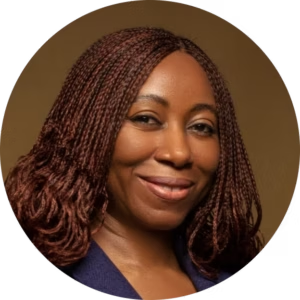
In this interview, we speak with Dr Olufolakemi Cole-Adeife (Lagos, Nigeria), who has been closely involved in developing and delivering a virtual training programme for Nigerian healthcare workers aimed at addressing many of these challenges. Following her presentation on the topic at the EADV Congress in 2025, we discussed the key lessons learned and the next steps to build on the programme’s success.
Q. What specific challenges do Nigerian health workers face in diagnosing and managing skin neglected tropical diseases?
There are very few dermatologists in Nigeria. The country has around 200 dermatologists serving a population of about 200 million people, which is roughly one dermatologist per one million. In addition, many of these specialists are concentrated in urban areas, whereas skin NTDs are more commonly found in rural and underserved regions. As a result, people in these communities often do not have access to dermatologists.
Dermatology training in Nigeria is also very limited for doctors and other healthcare professionals, including nurses and community health workers. This creates a significant challenge in diagnosing not only skin conditions in general but also skin NTDs. This lack of expertise often leads to patients presenting with the condition late, resulting in increased morbidity among those affected with skin NTDs. There is therefore a real need to intervene and address this fundamental problem.
Q. How was the training delivered, and what were some of the key components that made it effective?
The training really built on our experience from the COVID-19 pandemic, when many activities had to move online. We entered what I would call the era of Zoom, and we decided to take advantage of that change.
The advantage of virtual training is that you can reach a large number of people without needing to move them from where they live or work. It allows you to connect with participants from all over the country, which is especially important because Nigeria is a very large country.
We decided to reach out to people through social media, which is very popular in Nigeria, particuarly platforms such as Facebook, WhatsApp, Instagram and Twitter. We created flyers and posters targeted at healthcare workers, promoting a free skin neglected tropical diseases training programme. These included images of the conditions so that people could recognise what skin NTDs look like. We also let them know that we were aiming to share as much knowledge as possible on how to diagnose and manage these conditions, as well as how to treat or refer patients with these skin conditions.
We were quite surprised by the response. More than 1,500 people expressed interest in taking part, and we eventually registered around 1,076 participants with around 1,000 people actually joining the training. It really showed us that there was both a need and an interest. We had participants from all six geopolitical zones in Nigeria attending the training virtually, sharing their experiences, and learning about the various skin NTDs we aimed to cover. We also kept the sessions short to maintain attention, and overall, I think that worked really well.
Q. What impact did the virtual programme have?
To measure the impact of the programme we carried out a pre- and post-training evaluation. Participants were asked a few questions before the training started, and then we asked the same set of questions again after the training was completed.
We discovered that community health workers and nurses, in particular, showed much better scores at the end of the programme. Doctors also improved slightly, but I think as they already had some of the knowledge, the training served more as an update. The main frontline workers who treat people in rural areas, such as community health workers and community nurses, showed the most significant improvement in their knowledge when we compared their scores before and after the training.
As part of the programme, we also began developing a teledermatology app, which is still being built. This platform allows people to send pictures when they face challenges in diagnosing cases. A dermatologist can then review the images and provide recommendations, which for those working in the community we found also to be very helpful.
In summary, there were some very positive impacts of the programme. It helped to build capacity, increase dermatology knowledge among frontline health workers, and create a network of professionals focused on skin health, skin NTDs, and other dermatological conditions.
Q. How could this model be scaled or adapted to strengthen care for neglected tropical skin diseases?
I think it is important to continue building on this model. We received a lot of feedback from participants saying they would like us to keep organising online webinars from time to time and to make the initiative more long lasting. They also suggested including other common skin conditions in addition to skin NTDs. With that in mind, I am looking at expanding or scaling up the programme in the next two to three months by offering online webinars focused on common skin conditions, along with overviews of skin NTDs.
I am also still working on developing the teledermatology app I mentioned earlier, which healthcare professionals can use to share images (with patient consent) and receive input from dermatologists. This also provides users with an ongoing opportunity to keep learning about skin NTDs and other skin conditions. I am hopeful that this project will receive support so that we can continue developing and expanding it.
There is also the VisualDx platform, a dermatology triage tool. I was given the opportunity to provide free licences to about 150 frontline workers in Nigeria as part of my participation in the GLODERM Mentorship programme. This has been very impactful, and we are hoping to expand the initiative to reach more frontline health workers and, of course, the millions of people they treat across Nigeria.
Disclosures: Dr Olufolakemi Cole-Adeife has received grant/research support from La Roche-Posay.
This content has been developed independently by Touch Medical Media for touchDERMATOLOGY. It is not affiliated with the European Academy of Dermatology and Venereology (EADV). Views expressed are the speaker’s own and do not necessarily reflect the views of Touch Medical Media.
Cite: Virtual training model and app accelerates efforts to tackle skin neglected tropical diseases. touchDERMATOLOGY. October 01, 2025
Editors: Gina Furnival & Victoria Jones