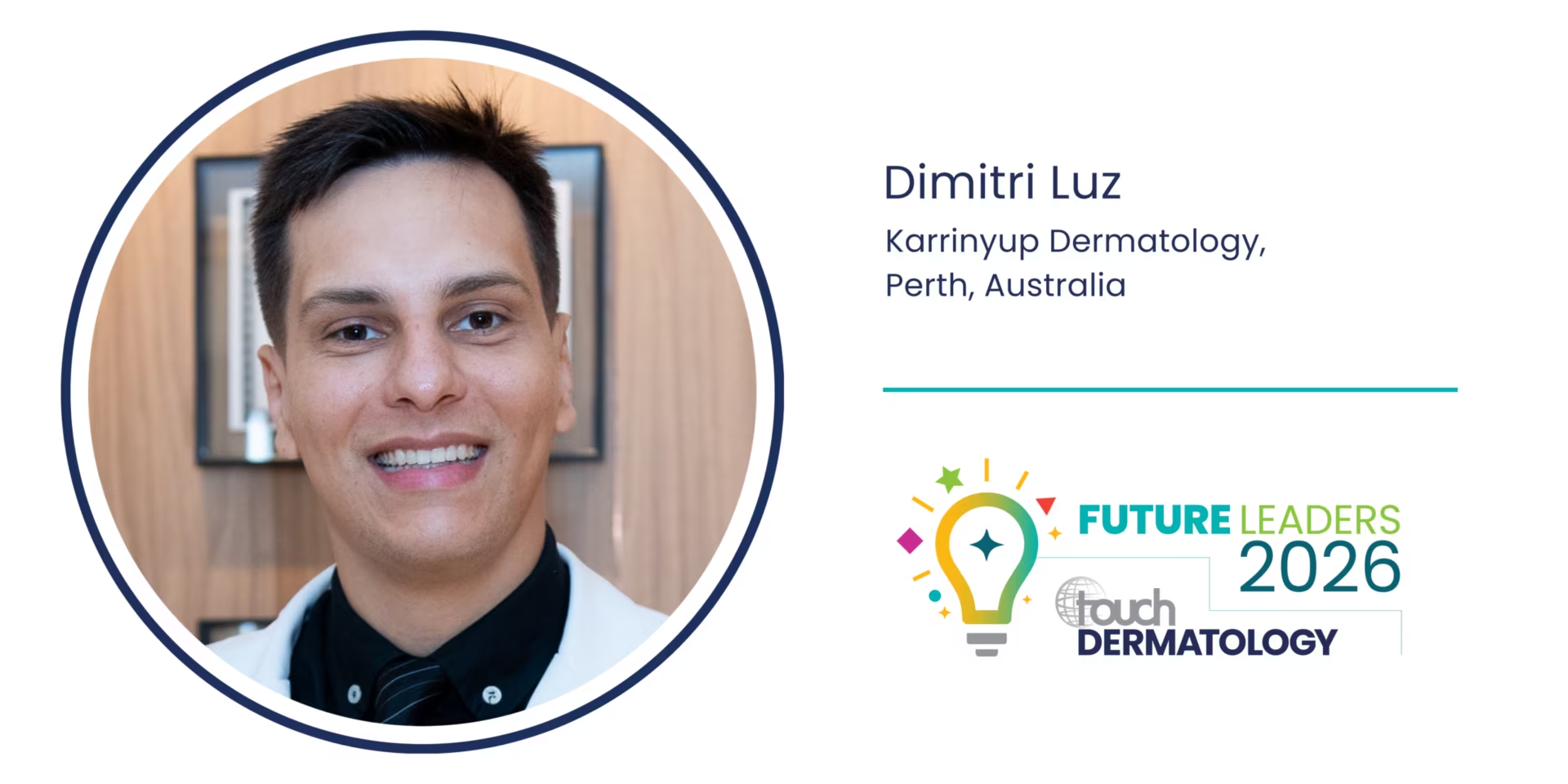
We are delighted to announce Dr Dimitri Luz as a touchDERMATOLOGY Future Leader 2026.
Dr Luz is helping to advance immune-mediated dermatology through his work in clinical care, research, and medical education.
A Brazilian-trained dermatologist now based in Perth, Australia, his principal areas of interest are psoriasis and hidradenitis suppurativa, alongside a broader range of complex inflammatory skin diseases.
His academic journey has included a master’s degree focused on psoriasis, ongoing PhD research into phenotypes in hidradenitis suppurativa, participation in clinical trials as a principal investigator and sub-investigator, and involvement in medical education. His work beyond clinical practice has also involved translational research at Johns Hopkins University (Baltimore, MD, USA) and international collaboration through the Group for Research and Assessment of Psoriasis and Psoriatic Arthritis (GRAPPA).
In this Q&A, Dr Luz discusses the experiences that drew him to dermatology, the mentors who shaped his approach to the specialty, and how translational research and clinical trials are supporting the development of more targeted treatments for immune-mediated skin diseases.
Q: What drew you to dermatology, and how did your interest in your current area of focus develop?
Dermatology fascinated me from the beginning because of its breadth, versatility, and, very often, its ability to provide a clear and meaningful solution for patients. It combines clinical medicine, oncology, and surgery, while allowing us to care for patients across very different stages of life and to deal with an enormous variety of diagnostic and therapeutic challenges.
During medical school, I was particularly struck by how closely skin disease could be connected to a patient’s psychological and social wellbeing. I remember seeing people affected by leprosy or severe acne who felt so self-conscious about their appearance that they avoided leaving home, sometimes sending their parents to collect prescriptions on their behalf. Those experiences made me realize very early that treating a skin disease is often about much more than treating the skin itself.
Later, through my dermatology training, I became increasingly interested in inflammatory and immune-mediated diseases. Psoriasis became one of the main focuses of my academic work, including my master’s degree and subsequent involvement in clinical research, teaching, and the management of patients receiving biologic therapies. My interests then expanded to a broader spectrum of immune-mediated diseases, including hidradenitis suppurativa, atopic dermatitis, alopecia areata, autoimmune blistering diseases, connective tissue diseases, pyoderma gangrenosum, and other complex inflammatory dermatoses.
Clinical research became an important part of this journey, giving me the chance to combine my clinical interests with research into emerging therapies across several of these conditions.
Alongside clinical practice and research, I developed an academic career in Brazil, teaching medical students, dermatology residents, and dermatologists and participating as a speaker and faculty member in national and international educational programs. My work in immune-mediated dermatology and clinical research ultimately brought me to Australia, where I see an opportunity to continue developing these areas in a new setting while contributing to the dermatology community in the country.
Q: Is there a specific patient, mentor, or experience that shaped your path in this field?
I have had several important mentors throughout my career, but Dr Renata Magalhães holds a special place in my journey. She was an early and profound influence on my development as a dermatologist and became, in many ways, my ‘dermatological mother’.
What influenced me most was not simply her knowledge of dermatology, but her approach to the profession. She showed me the importance of combining strong clinical reasoning with curiosity, academic work, teaching, and a genuine commitment to patients. That example had a lasting influence on the kind of dermatologist I wanted to become.
That influence extended well beyond our early years together. As my career developed across clinical practice, teaching, and research, I kept returning to lessons I first learned from her: to stay curious about difficult cases, to teach as I learned, and to never separate the academic question from the person in front of me.
I was fortunate to find that same spirit in other mentors and collaborators along the way, from my early research experience at Johns Hopkins to my later involvement with GRAPPA and international psoriasis networks. Each relationship shaped a different part of my career, but the foundation Dr Magalhães built has stayed the same: dermatology as a clinical specialty, an academic discipline, and a field where there is still a great deal to discover.

“Each relationship shaped a different part of my career, but the foundation Dr Magalhães built has stayed the same: dermatology as a clinical specialty, an academic discipline, and a field where there is still a great deal to discover.”
Dimitri Luz
Q: What current innovations in dermatology excite you the most?
What excites me most is the development of new therapeutic mechanisms and the way our growing understanding of disease biology is translating into meaningful advances across immune-mediated dermatology.
I first became interested in translational research during my time at Johns Hopkins, where I was exposed to research that connected biological mechanisms with clinical questions. That experience stayed with me and helped shape my interest in understanding not only whether a treatment works, but why it works and which patients are most likely to benefit from it.
This is particularly exciting in dermatology because we are seeing this process happening across so many different diseases. Advances in psoriasis have already shown how understanding specific immune pathways can transform treatment, and I am now seeing a similar shift across other diseases I work with, including hidradenitis suppurativa and alopecia areata.
Clinical trials are a particularly fascinating part of this process for me. Running or contributing to a trial puts you at the point where scientific discoveries become potential treatments. It also gives clinicians an early view of therapies and mechanisms that may shape clinical practice in the coming years.
I find that particularly rewarding because it is not simply about having access to new treatments before they become widely available. It is about understanding the science behind them, contributing to their development, and being able to anticipate how the therapeutic landscape may evolve. For me, that connection between immunology, translational research, and clinical trials is one of the most exciting aspects of modern dermatology.
Disclosures: This short article was prepared by touchDERMATOLOGY in collaboration with Dr Luz. No fees or funding were associated with its publication.
Citation: Dr Dimitri Luz on a global path to advancing clinical care, research, and education in immune-mediated dermatology: touchDERMATOLOGY Future Leaders 2026. touchDERMATOLOGY. XX September 2026.
Register now to receive the touchDERMATOLOGY newsletter!
Don’t miss out on hearing about our latest peer reviewed articles, expert opinions, conference news, podcasts and more.