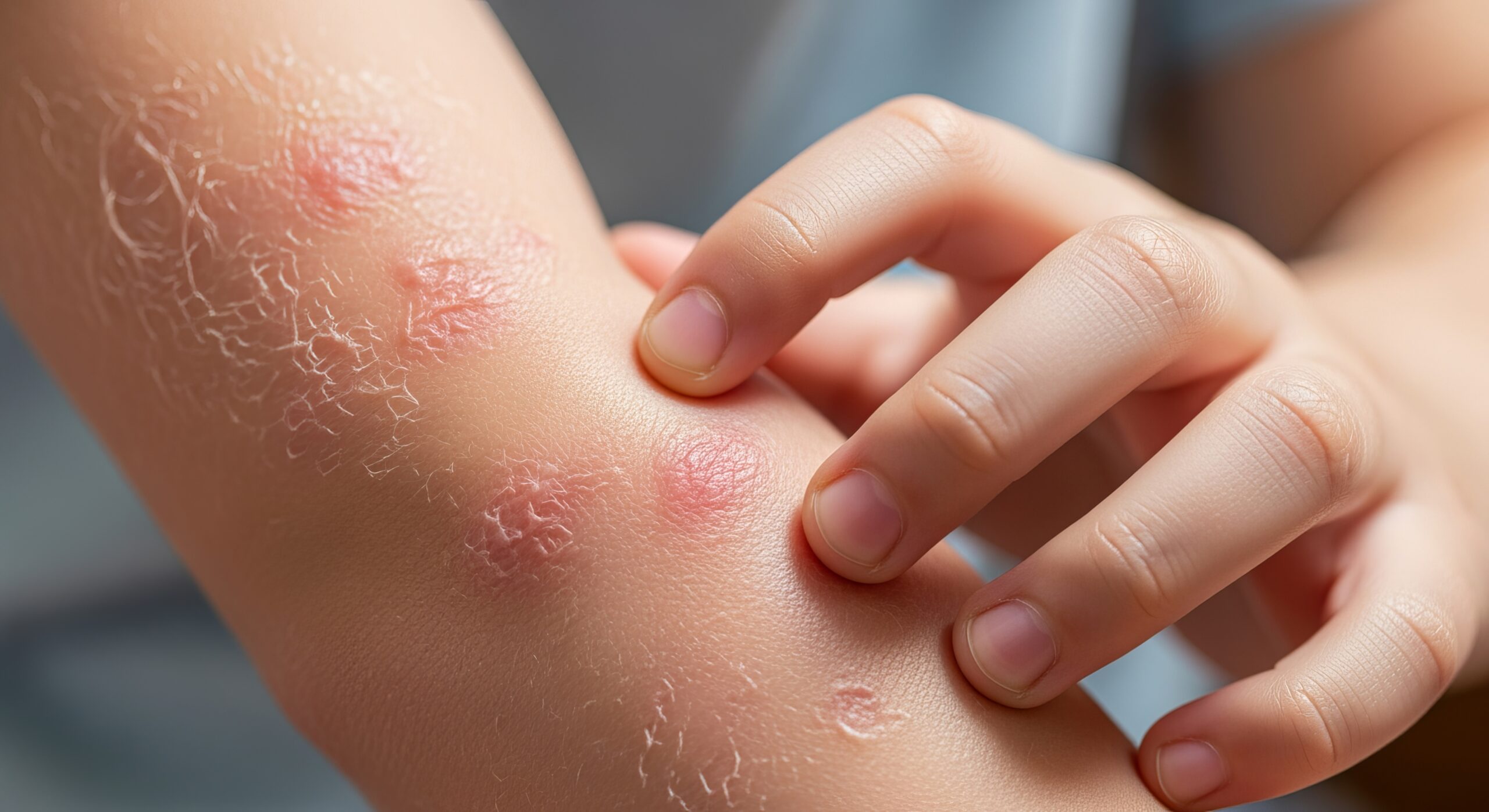
Dr Gkini discusses the role of psychodermatology in supporting patients’ wider needs and explores emerging approaches to psoriatic disease.
Psychodermatology is increasingly recognized as an important part of dermatological care, reflecting the close relationship between skin disease and psychological wellbeing. At the 2026 British Academy of Dermatology (BAD) Annual Meeting (Manchester, UK) several sessions explored the psychological, social and behavioral dimensions of skin disease, as well as emerging research in this area.

We also explore a topic that is likely to be front of mind for many healthcare professionals in the field of dermatology: the future management of psoriatic disease. This was a recurring theme throughout the meeting and the focus of an educational sponsored symposium presented by Dr Gkini.
Psychodermatology at BAD 2026
Results from the national virtual psychodermatology MDT
Q. Your group has established a UK national virtual psychodermatology multidisciplinary team. What gap was it designed to address, and what impact has it had so far?
Psychodermatology is an exciting area of dermatology that brings together dermatology, psychiatry and psychology.
Many people with inflammatory skin conditions are significantly affected by their condition, and numerous surveys have highlighted the extent of this burden. However, there is still a major gap in care. When patients attend a busy clinic, they can feel dismissed. Few clinicians ask them, “How do you feel? Are you coping?”
The reality is that when we ask these questions, many patients become emotional and may even say, “You are the first person who has asked me that.” Clinics are busy, appointments are short, and we often have limited time to assess and treat each patient. We do have advanced treatments available, but patients need more than this. They need a more holistic approach. This is where psychodermatology can help to bridge the gap and support patients more fully.
In our department, we are fortunate to have a dedicated psychodermatology clinic, where dermatologists and psychiatrists work together in the same room. This means we can prescribe psychotropic medication alongside dermatological treatments, to help and support our patients more fully.
Through the virtual psychodermatology multidisciplinary team (p-MDT), we hope to extend this model of care and support our colleagues in managing the growing number of patients who need, but do not have access to, dedicated psychodermatology services.
When we talk about patients requiring psychodermatology care, there are broadly two groups. The first includes patients with a dermatological condition that leads to secondary psychosocial comorbidities. The second includes patients with a primary psychiatric condition that presents with secondary skin symptoms and signs.
Through the virtual p-MDT, our aim is to provide advice and guidance to colleagues managing complex patients, so that patients can be treated locally without a need for referral to a specialist center which may take years. This service is carefully governed, with robust processes in place to ensure that all information shared is handled safely and appropriately.
Overall, the feedback has been very positive. Of referrers who responded to the feedback questionnaire, 95% found the p-MDT to be useful or extremely useful, and reported that they would use the service again.
We have seen that clinicians really value having access to specialist support so that they can manage these cases locally, while patients also feel better supported and benefit from more timely and coordinated care. Importantly, the virtual service has also helped reduce the number of appointments required. Overall, satisfaction with the p-MDT is high among clinicians, departments, and patients.
→ Abstract: Patel M, Ahmed F, Lim Z, et al. From conception to clinical impact: a review of the first national virtual psychodermatology multidisciplinary team in the UK. British Journal of Dermatology, Volume 195, Issue Supplement_1, June 2026, ljag086.643.
Psychosocial impact of CSU and CindU
Q. Urticaria Voices was a multinational online survey of adults with chronic urticaria and physicians who manage the condition. At BAD 2026, you presented a UK analysis of this data exploring the experiences of patients with chronic spontaneous urticaria (CSU) and concomitant chronic inducible urticaria (CIndU). Could you tell us about the analysis and the key findings?
Until recently, treatment options for urticaria have been very limited, and despite advances there still remain many unmet needs in this population. Through this study, we wanted to understand how patients feel about their condition and how physicians perceive the experiences of people living with urticaria.
The burden of the condition is significant. Interestingly, what we found was that some physicians perceived the disease as more severe than the patients themselves did. Definitely the concept of alexithymia should be considered in the urticaria population.
The data also highlighted that many patients have been suffering in silence for a long time and have not had an effective treatment.
In total, 88% of patients said their disease was inadequately controlled, and most reported a moderate-to-severe impact across multiple areas of their lives, including daily activities, family life, emotional wellbeing, relationships, work, and finances. Stigma was also common, with some patients reporting that they had been stared at, asked whether they were contagious, discriminated against, or humiliated in public.
Ultimately, we need intervene early, offer a wider range of treatment options and take a more holistic approach to their care.
→ Abstract: Maria-Angeliki Gkini, Tariq El-Shanawany, Sinisa Savic, et al. Urticaria Voices: Persistent symptoms and quality-of-life burden in patients with chronic spontaneous urticaria and chronic inducible urticaria: findings from the Urticaria Voices study in the UK British Journal of Dermatology, Volume 195, Issue Supplement_1, June 2026, ljag086.670.
Hair loss: it is not just hair
Hair disorders and psychodermatology
Q. At the joint European Society for Dermatology and Psychiatry (ESDaP) and Psychodermatology UK session, your invited talk focused on hair disorders and psychodermatology. What were the key take-home messages?
This is a topic very close to my heart because my PhD focused on hair diseases. For this discussion, I think it is particularly important to focus on alopecia areata (AA). AA is a systemic condition with a significant psychosocial burden for patients. Rates of depression and anxiety are high, and there is a growing body of evidence highlighting this burden.
Interestingly, a systematic review and meta-analysis found that more than half of patients with AA experience alexithymia, meaning they may struggle to identify and express how they feel.
The unpredictable nature of AA is also a major source of stress for patients. There is growing interest in the role of stress, although more research is needed because the relationship appears to work in both directions. Some patients describe experiencing a traumatic event before their hair loss began. Others say that developing AA led to increased stress and anxiety. We therefore need further research to better understand this complex relationship.
The stigma associated with AA remains a significant issue, and it is important that we recognize the condition as much more than a cosmetic concern. It can have a profound impact on a person’s psychological and social well being, so we need to screen patients for psychiatric and psychosocial comorbidities as part of routine care.
We are fortunate to now have more treatment options available for AA, such as JAK inhibitors, but treatment must still be holistic. We also need to support not only the patient, but also the people around them. This is particularly important for children and young people, for whom the condition can also affect parents, siblings, or the wider family.
Ultimately, we need to care for managing patients with AA as a whole, rather than treating just the hair loss.
AI & the future of dermatology
Dermatology on social media
Q. Your recent research into TikTok influencer content relating to atopic dermatitis and topical steroid withdrawal was presented during the artificial intelligence (AI) and social media session. What was the rationale for the study, and what were your key conclusions?
There is now a significant amount of misinformation about atopic dermatitis and topical steroid withdrawal circulating on social media. We are increasingly seeing patients come into clinic saying that they get their information from TikTok or particular influencers, especially within the topical steroid withdrawal community.
Patients are saying, “I saw this online, I would like to have treatment X for my condition.” So what we are seeing is that there is still a great deal of mistrust towards physicians, and the proposed therapeutic pathway, particularly within the topical steroid withdrawal community.
We therefore wanted to gather both qualitative and quantitative data to better understand the source of information for patients, what content they are exposed to, and how this may influence their views.
As part of the survey, we analyzed responses from 103 patients. We found that many patients obtain advice and information from social media channels. As clinicians, we need to be much more proactive in providing clear, accurate, and evidence-based information, not only in our clinics and consultations, but also by providing relevant information on social media platforms.
Will we always be successful? Realistically, probably not. However, it remains essential that we continue to communicate the evidence clearly and help patients make informed decisions. As clinicians, we have a responsibility to educate patients and provide accurate information.
There is already important work taking place in this area. For example, the European Academy of Dermatology and Venereology (EADV) advocacy group is doing excellent work to raise awareness about tanning beds, the need for sun protection, and the burden of inflammatory conditions. There are many ways to reach patients, particularly younger people, and build trusting relationships that can support greater engagement and better treatment outcomes.
→ Abstract: Al-Temimi & Gkini M. Dermatology and social media: an analysis of influencer content on atopic dermatitis and topical steroid withdrawal. British Journal of Dermatology, Volume 195, Issue Supplement_1, June 2026, ljag086.263.
The future of treating psoriatic disease
Q. You presented during a sponsored symposium on the future management of psoriatic disease. What advances are likely to shape the treatment of psoriasis in clinical practice?
A hot topic! Everyone is talking about precision medicine, and it is really about trying to take the next step in that direction.
The big question is: are we there yet? The answer is no, but things are changing rapidly, particularly with advances in technology, digital tools and AI. What we do know is that the clinics of five years from now are likely to look completely different from those we do today.
First of all, there are new treatment options coming, with the psoriasis treatment landscape changing rapidly, especially with the new oral molecules.
Moreover, there are now AI-developed tools that can assess disease severity. For example, they can calculate the Psoriasis Area and Severity Index (PASI) for psoriasis or the Eczema Area and Severity Index (EASI) for atopic dermatitis. This is something we are likely to see used much more routinely in clinical practice, rather than in research.
Looking further ahead, molecular diagnostics could also play an important role. At the moment, we see many patients where it is unclear whether they have psoriasis or eczema. We may perform a biopsy and still not be certain. Molecular diagnostics can help us reach the correct diagnosis and, ultimately, provide patients with the most appropriate care.
We are also going to see greater use of teledermatology. Organizations such as the International Psoriasis Council have developed a consensus paper on how treatment can be initiated and how people with psoriatic disease can be monitored remotely. This is likely to become much more common in clinical practice.
Beyond that, we are not quite there yet, but AI-based prediction models may also have an important role. At the moment, choosing the right biologic treatment for a particular patient is largely a process of trial and error. In the near future, however, AI tools could help guide us towards the right treatment for the right patient.
There is a great deal of discussion around biomarkers that could help with treatment selection , but unfortunately, at least in psoriatic disease, we have not yet identified sufficiently reliable biomarkers to support treatment selection. This is where digital biomarkers may be particularly helpful.
We are also likely to see more prognostic models that can help predict comorbidities. For example, among patients with psoriasis, who is likely to develop psoriatic arthritis, and when?
This also relates to the concept of early intervention. In the future, we may be able to identify which patients are most likely to benefit from receiving early treatment for their disease, but also the ones who will remain in remission.
Some people may ask whether AI is the panacea. The answer is no, definitely not. There are still many caveats, and we are only beginning to understand how these tools can be used to improve the patient care.
In conclusion, looking to the future, the clinic of tomorrow, particularly in psoriatic disease, is going to look completely different. These developments will probably bring us one step closer to better patient care and precision medicine.
Disclosures: Dr Gkini discloses serving as an investigator, advisory board member and/or speaker, and receiving fees, honoraria, educational support and/or travel grants from NIHR studies, AbbVie, Novartis, Johnson & Johnson, Almirall, LEO Pharma, UCB, Pharmaserve Lilly, Sanofi, Pfizer, Oruka Therapeutics, Incyte, Nektar, Amgen, argenx, MSD, Bristol Myers Squibb, Galderma, L’Oréal, Beiersdorf and Skin + Me/Hair + Me.
This content has been developed by Touch Medical Media for touchDERMATOLOGY in collaboration with Dr Gkini. It is not affiliated with the British Academy of Dermatology (BAD). Views expressed are the speaker’s own and do not necessarily reflect the views of Touch Medical Media.
Editor: Gina Furnival, Head of content
Cite: The growing role of psychodermatology and the future of psoriatic disease. TouchDERMATOLOGY. October 14, 2026
SIGN UP to TouchDERMATOLOGY!
Join our global community today for access to thousands of peer-reviewed articles, expert insights, and learn-on-the-go education across 150+ specialties, plus concise email updates and newsletters so you never miss out.