Open Nav
Open Nav
touchMEETING HIGHLIGHTS
What Went Wrong? How Dysregulated Type 2 Immunity Contributes to AD, PN, CSU, and BP
How Does Protective Type 2 Immunity Become Harmful Type 2 Inflammation?
In this video, Dr Eric Simpson discusses how protective type 2 immunity can become dysregulated, leading to harmful type 2 inflammation. The associated inflammatory process can contribute to the pathophysiology of several dermatological diseases, including atopic dermatitis (AD), prurigo nodularis (PN), chronic spontaneous urticaria (CSU), and bullous pemphigoid (BP).
Under the Itchy Surface: The Insidious, Cumulative Burden of Type 2 Inflammation in AD
In this video, Dr Eric Simpson discusses the systemic nature of atopic dermatitis (AD) and how the disease burden extends beyond the skin. Through the lens of cumulative life course impairment, Dr Simpson goes on to explore how persistent type 2 inflammation in AD may drive both atopic and nonatopic comorbidities, emphasizing the potential importance of early and effective therapeutic intervention to alter disease progression
Inside the Hive: Type 2 Inflammatory Pathways in Chronic Spontaneous Urticaria
Join Dr Jason Hawkes in discussing the burden of chronic spontaneous urticaria (CSU) and how type 2 inflammation contributes to the development of chronic wheals (hives) and angioedema
Expert Interview: Featuring Dr Jason Hawkes
In this video, Dr Jason Hawkes outlines the burdens and challenges facing patients with chronic spontaneous urticaria (CSU). Dr Hawkes then goes on to discuss how type 2 inflammation contributes to the development of wheals and itch.
Expert Interview: Featuring Dr Shawn Kwatra
Join Dr. Shawn Kwatra in this expert video as he uncovers the diverse clinical presentations of prurigo nodularis (PN), multifaceted patient burden, and key drivers of pathophysiology, including how type 2 inflammation contributes to PN signs and symptoms.
Importance of Early Diagnosis in Bullous Pemphigoid
Join Dr. Victoria Werth in this expert video as she discusses key features of bullous pemphigoid (BP), including clinical characteristics and diagnosis, multifaceted patient burden, and the role of type 2 inflammation in disease pathogenesis
Expert Videos




Check your Inbox
We've sent your certificate

Thank you
for your Feedback!
Expert Videos
Activity Overview
Faculty & Disclosures
Overview
Faculty & Disclosures

Eric Simpson, MD
Oregon Health & Science University, Portland
Biography
Eric Simpson, MD, MCR, practices medical dermatology with special interests in chronic inflammatory skin diseases and skin cancer. He is actively involved in clinical research and is currently funded by the National Institutes of Health and industry partners to study new approaches to chronic skin disease treatment and prevention.
His collaborations are global in scope, and he has been invited to present his research and approach to patient care at international conferences in Europe, North and South America, and Asia. He has published over 290 scientific articles in several high-impact peer-reviewed journals including the New England Journal of Medicine and The Lancet.
He supports patient advocacy and improving research quality by serving as Co-Chair of the Harmonizing Outcome Measures in Eczema (HOME) – a volunteer group of patients, providers, and other stakeholders whose mission is to improve the quality of eczema research to better suit the needs of patients and policy-makers. He is also serving as Chair of the NEA Research Advisory Committee.
Disclosures
Research funding AbbVie, Acrotech Biopharma Inc, Amgen, Arcutis, Aslan, Castle Biosciences, CorEvitas, Dermavant, Dermira, Eli Lilly, Incyte, Kymab, Kyowa Kirin, National Jewish Health, Leo, Pfizer, Regeneron, Sanofi, Target RWE, VeriSkin. Speaker and/or consulting fees AbbVie, Amgen, Arcutis Biotherapeutics, Areteia Therapeutics, Bristol Myers Squibb – BMS, CorEvitas, Corvus, Dermira, Eli Lilly, Evelo Biosciences, FIDE, Forte Bio RX, Galderma, GlaxoSmithKline, Gilead Sciences Inc, Impetus Healthcare, Incyte, Innovaderm Reche, Janssen, Johnson & Johnson, Kyowa Kirin Pharmaceutical Development, Leo Pharm, Merck, NUMAB Therapeutics AG, Pfizer, Physicians World LLC, PRImE, Recludix Pharma, Regeneron, Roivant, Sanofi-Genzyme, SITRYX Therapeutics, Tervi Therapeutics, Valeant.
Victoria Werth, MD

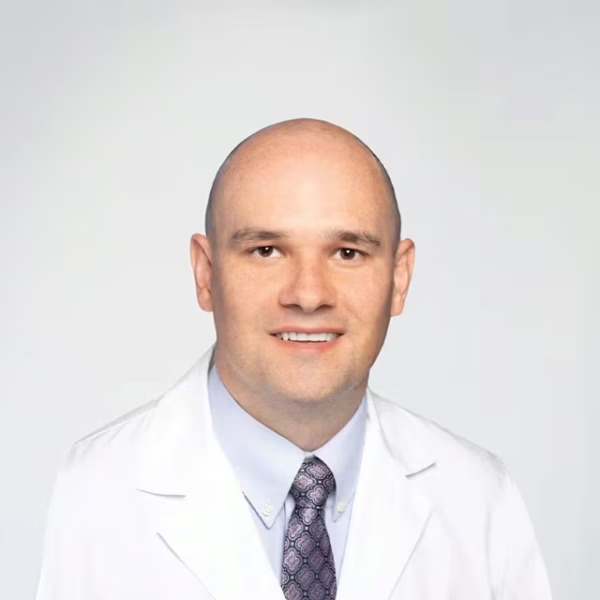
Jason Hawkes MD, MS

Jason Hawkes MD, MS
Oregon Medical Research Center in Portland, OR
Biography
Dr Hawkes is a board-certified dermatologist and Investigator at the Oregon Medical Research Center in Portland, OR. He completed his medical school and residency at the University of Utah. During medical school, he was selected for a fellowship in translational immunology in the HHMI Research Scholars Program at the NIH. He also received a Master’s Degree in Clinical Investigation from Rockefeller University, where he was Chief Clinical Scholar and Principal Investigator on multiple human research protocols in the Laboratory for Investigative Dermatology. He has held academic appointments in the Departments of Dermatology at the University of Utah, Icahn School of Medicine at Mount Sinai, and University of California-Davis.
Dr Hawkes is a current Councilor in the International Psoriasis Council and serves on the NPF Medical Board and Scientific Advisory Committee. He also serves as the official delegate of the AAD as a member of the international guidelines and workgroup committee for urticaria. His research has been funded by the NIH, NSF, NPF, and Dermatology Foundation, and he is the recipient of several teaching awards including NPF Outstanding Educator in Psoriatic Disease and Exceptional Teacher of the Year in the Department of Dermatology at Mount Sinai. His primary clinical and research interests include novel immune therapies for inflammatory conditions like psoriasis, atopic dermatitis, hidradenitis suppurativa, alopecia areata, vitiligo, and chronic urticaria.
Disclosures
Medical/scientific board Medical board, National Psoriasis Foundation Scientific Advisory Committee, National Psoriasis Foundation Councilor, International Psoriasis Council. Speaker and/or consulting fees Apogee, Arcutis, BI, Blueprint Medicines, BMS, Boxer Capital LLC, Cogent Biosciences, Galderma, Institute for Systems Biology, Janssen, LEO, Novartis, Regeneron, Sanofi, Sun Pharma, Takeda, UCB.
Eric Simpson, MD


Shawn Kwatra, MD

Shawn Kwatra, MD
University of Maryland School of Medicine, Baltimore, MD
Biography
Dr Shawn Kwatra is the Joseph W. Burnett Endowed Professor and Chairman of Dermatology at the University of Maryland School of Medicine in Baltimore, MD, USA. He is an internationally renowned dermatologist and clinical leader in skin of color research, as well as chronic inflammatory skin diseases, including atopic dermatitis, prurigo nodularis, and chronic pruritus of unknown origin. Dr. Kwatra also has expertise in managing cutaneous adverse events associated with immunotherapy.
He specializes in medical dermatology, and is board certified by the American Board of Dermatology. His areas of clinical expertise include chronic pruritus, prurigo nodularis, atopic dermatitis and dermatology for ethnic skin. Dr. Kwatra’s primary clinical and translational research interests comprise the pathogenesis and treatment of chronic pruritus and he is funded by the National Institutes of Health and multiple foundations. Dr. Kwatra obtained his undergraduate degree from Duke University and undertook his medical training at Wake Forest University of Medicine. He completed his dermatology residency training at the Johns Hopkins University School of Medicine.
Dr Kwatra has been an author or co-author on over 270 publications in peer-reviewed international journals and is a member of several professional organizations, including the American Academy of Dermatology, the Society for Investigative Dermatology, the International Forum for the Study of Itch and is currently serving on the Board of Directors of the Skin of Color Society.
Disclosures
Research funding Pfizer, Sanofi, Incyte. Speaker and/or consulting fees AbbVie, Arcutis, Galderma, Incyte, Pfizer, Sanofi, Regeneron, Janssen.
Jason Hawkes MD, MS
Victoria Werth, MD

Victoria Werth, MD
University of Pennsylvania and Veteran's Administration Medical Center Philadelphia, PA
Biography
Dr Werth received her MD from Johns Hopkins School of Medicine, followed by residency and a postdoctoral research fellowship in Immunodermatology at New York University. Dr Werth moved to Penn in 1989 as Chief of Dermatology at the Philadelphia VA Hospital. At Penn she directs the Autoimmune Skin Disease study unit, and performs clinical and translational research studies in autoimmune skin disease funded by NIH, autoimmune foundations, and industry. She has performed a number of industry trials for pemphigus and bullous pemphigoid. She has a basic research lab at the VA devoted to autoimmune skin disease and photobiology, funded by NIH and the VA.
Dr Werth’s clinical practice specializes in the diagnosis and treatment of patients with autoimmune skin diseases, including autoimmune blistering disease, lupus erythematosus, and dermatomyositis. She led an international effort to develop disease severity tools for several autoimmune blistering diseases, including pemphigus and bullous pemphigoid. These tools are now used in international trials that are developing new drugs for autoimmune blistering diseases, including the trial leading to the recent FDA approval of Rituximab for pemphigus vulgaris.
Dr Werth has also performed studies to determine the impact of bullous diseases on Quality-of-life. Her research laboratory has determined the heterogeneity of the inflammatory cell infiltrate in skin in photo-induced autoimmune skin diseases, and correlated this with the response to therapy. Her laboratory has also performed translational research to better understand how novel therapies that modulate inflammatory cells work in autoimmune skin disease. She has been on the IPPF Medical Advisory Board since the beginning of the foundation.
Dr Werth has received numerous honors for her work, including the lifetime achievement award from the Medical Dermatology Society, the Rose Hirschler Award from the Women’s Dermatologic Society, and the American Skin Associations’s Research Achievement Award in Autoimmune & Inflammatory Skin Disorders, the Lifetime Career Educator Award from the Dermatology Foundation, and the Naomi Kanof Clinical Investigator Award from the Society of Investigative Dermatology.
Disclosures
Research funding Amgen, AstraZeneca, Biogen, BMS, Corbus Pharmaceuticals, CSL Behring, Gilead, Horizon, Pfizer, Priovant, Regeneron, Rome Pharmaceuticals, Ventus, Viela. Speaker and/or consulting fees AbbVie, Alpine Immune Sciences, Amgen, Anaptysbio, Argenx, AstraZeneca, Biogen, BMS, Cabaletta Bio, Calyx, Caribou, Crisalis, CSL Behring, Cugene, EMD Sorona, Evommune, Gilead, GSK, Horizon, Immunovant, Innovaderm, Janssen, Kyowa Kirin, Lily, Merck, Nektar, Nuvig Pharmaceuticals, Pfizer, Regeneron, Rome Pharmaceuticals, Sanofi, Takeda, UCB, Ventus, Viela Bio, Xencor
Shawn Kwatra, MD
Eric Simpson, MD
Expert Videos
touchMEETING HIGHLIGHTS
This content is intended for healthcare professionals only.
Please confirm that you are a healthcare professional.


This activity has been sponsored by Sanofi and Regeneron Pharmaceuticals, Inc. Sanofi and Regeneron Pharmaceuticals, Inc. provided financial support and video content, and have had input into the detailed project scope. This activity is provided by Touch Medical Communications (TMC) for touchDERMATOLOGY. ADVENT is a global medical education non-promotional program by Sanofi and Regeneron. Content is intended for scientific exchange purposes only.
Close Popup
Could not verify Country/IP Address.
We were unable to verify your IP address, please try again later. If you are using a method to hide your IP address, such as a VPN or proxy, please disable this and try again.
This activity has been sponsored by Sanofi and Regeneron Pharmaceuticals, Inc.
Sanofi and Regeneron Pharmaceuticals, Inc. provided financial support and video content, and have had input into the detailed project scope. This activity is provided by Touch Medical Communications (TMC) for touchDERMATOLOGY. ADVENT is a global medical education non-promotional program by Sanofi and Regeneron. Content is intended for scientific exchange purposes only.
Unapproved products or unapproved uses of approved products may be discussed; these situations may reflect the approval status in one or more jurisdictions. TMC has advised the sponsor to ensure that they disclose any such references made to unlabelled or unapproved use. No endorsement by TMC of any unapproved products or unapproved uses is either made or implied by mention of these products or uses in TMC activities. TMC accepts no responsibility for errors or omissions.
The views and opinions expressed are those of the faculty and do not necessarily reflect those of any sponsor.
MAT-GLB-2504783 – 1.0 – 08/2025
Log into your Touch Account
Keep track of your clinical interests and newsletter subscriptions.
Sign up with an Email
Or use a .
Register now for FREE access
Already registered? Login below.