HiSCR was achieved by 60.0% of patients at Week 16 and by 77.4% of patients at Week 24, with no unexpected safety signals observed.
 Bimekizumab, a monoclonal antibody that selectively inhibits interleukin-17A and interleukin-17F, was recently approved for the treatment of moderate-to-severe hidradenitis suppurativa (HS). However, how does bimekizumab perform in everyday clinical practice for people living with HS?
A retrospective multicenter study performed across Italian dermatology referral centers explored bimekizumab’s effectiveness and safety, including in patients with severe disease and previous biologic exposure.
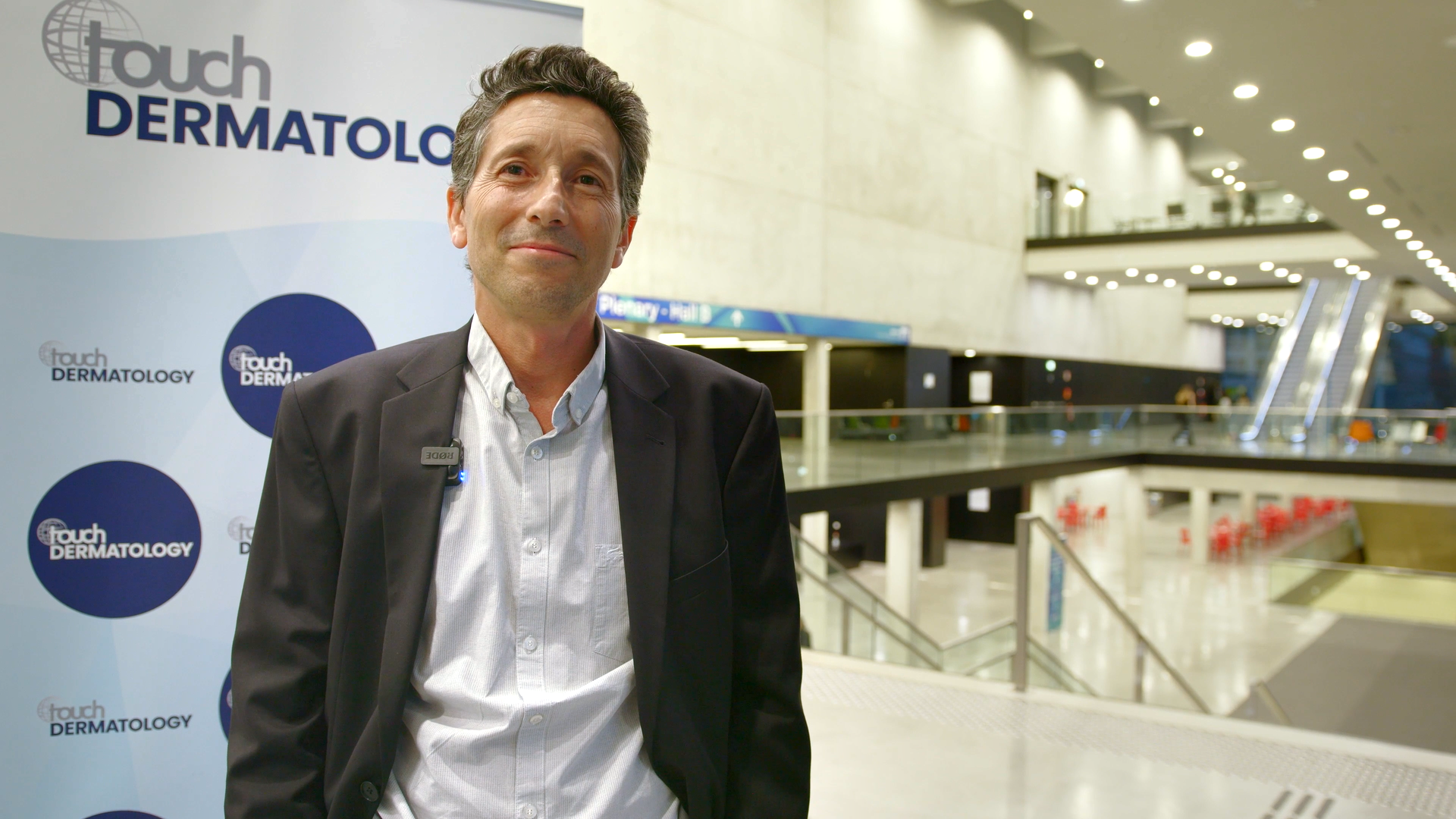
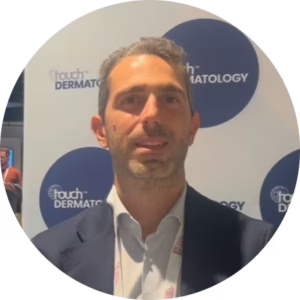
Our Editorial Board member, Dr Mario Valenti (IRCCS Humanitas Research Hospital, Rozzano, Milan, Italy) presented the findings during the European Hidradenitis Suppurativa Foundation (EHSF) session at the European Academy of Dermatology and Venereology (EADV) Congress 2026, adding to the limited real-world evidence on this treatment for moderate-to-severe HS.
Study population and outcomes assessed
The study included 100 patients, of whom 56% were male, with a mean age of 37.3 years and a median body mass index of 26.8 kg/m². Most had Hurley stage III disease (75%), and 80% had previously received a biologic therapy.
Researchers assessed effectiveness at Weeks 4, 16, and 24, examining changes in disease activity, pain, and quality of life. At the time of data lock, 53 enrolled patients had reached Week 24. Safety and tolerability factors were also recorded.
Clinical responses observed from Week 4, alongside improvements in pain and quality of life
Clinical responses were observed as early as Week 4, when 36% of patients achieved HiSCR, rising to 60% at Week 16. Among the 53 patients who had reached Week 24, 77.4% achieved HiSCR. The more stringent HiSCR75 response followed a similar pattern, achieved by 24%, 48%, and 66% at Weeks 4, 16, and 24, respectively.
Disease severity also improved. The median International Hidradenitis Suppurativa Severity Score System (IHS4) score fell from 18 at Baseline to 7 at Week 24, with 54.7% of evaluable patients achieving a reduction of at least 55% (IHS4-55). The median abscess and inflammatory nodule count decreased from 3.5 to 1, while median draining tunnel counts were significantly lower than Baseline at every assessment. Flare rates remained below 10% throughout follow-up.
Patients also reported improvements in pain and quality of life. By Week 24, the median pain numerical rating scale score had fallen from 8 to 3, and the median Dermatology Life Quality Index score from 19.5 to 7.
Safety findings show no unexpected signals
Adverse events were reported in 22% of patients during follow-up. These were noted as mild to moderate in severity, and no serious events or unexpected safety signals were reported.
Fungal infections were the most common adverse events, including candidiasis in 14% of patients. These infections were successfully treated with topical or systemic antifungal therapies, and no patients permanently discontinued bimekizumab during the available follow-up.
Some patients required rescue treatment: 4% at Week 4, 10% at Week 16, and 5.7% of the 53 patients who had reached Week 24. Oral antibiotics were the most commonly used option.
Real-world findings reinforce trial evidence and support longer follow-up
Concluding his presentation and speaking with touchDERMATOLOGY, Dr Valenti highlighted that the findings from this Italian multicenter study support the effectiveness of bimekizumab in everyday clinical practice, building on evidence from previous trials in moderate-to-severe HS. He also noted that experience with bimekizumab in psoriasis has helped clinicians manage potential side effects, while longer follow-up will provide a clearer picture of its performance over time.
Sources:
This information was presented at the EADV Congress 2026, Vienna, 30 September–3 October 2026. More information about the meeting is available here.
Related presentation: Valenti M. Real-world outcomes of bimekizumab in hidradenitis suppurativa from the Italian landscape hidradenitis suppurativa group. Presented at: EADV Congress 2026; 1 October 2026; Vienna, Austria.
Full article: Valenti M, Ingurgio RC, Ibba L, et al. Real-world effectiveness and safety of bimekizumab for moderate-to-severe hidradenitis suppurativa: A multicenter retrospective study from the Italian Landscape HS (IL-HS) [on behalf of the Italian Landscape HS (IL-HS) Study Group]. Dermatol Ther (Heidelb). 2026;16:5069–84.
Cite: Real-world outcomes of bimekizumab in hidradenitis suppurativa. touchDERMATOLOGY. 14 October, 2026.
Disclosures: No funding was received for the publication of this content. We thank Dr Valenti for sharing his expert perspectives. Dr Valenti discloses serving as a consultant and/or speaker for Sanofi, LEO Pharma, Eli Lilly and Company, Novartis, Janssen Pharmaceuticals, AbbVie, and Boehringer Ingelheim
Editor: Gina Furnival, Head of Content
touchDERMATOLOGY coverage of EADV 2026: This content has been developed independently by Touch Medical Media for touchDERMATOLOGY. touchDERMATOLOGY was an official media partner of the EADV Congress 2026. touchDERMATOLOGY is not affiliated with the EADV. Views expressed are the speaker’s own and do not necessarily reflect the views of Touch Medical Media.