
TouchDERMATOLOGY coverage from AAD 2026:
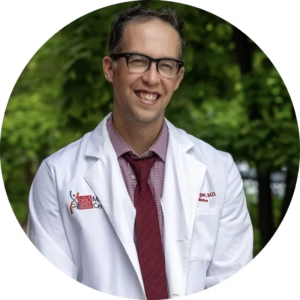
Having reported on this programme last year, we were delighted to speak again with Dr Ben Kaffenberger (Ohio, USA) about the latest findings from the Phase 3 trial of vilobelimab in pyoderma gangrenosum (PG), presented during a late-breaking session at the 2026 AAD Annual Meeting, held in Denver, CO, USA, from 27 to 31 March 2026.
Building on insights from the Phase 2 study, this pivotal Phase 3 trial is evaluating the efficacy of vilobelimab in PG and may support future FDA approval.
Despite the severity of PG, there are currently no approved treatments in the USA or Europe, leaving patients with limited options and a substantial unmet need. Although the exact pathophysiology of PG remains unclear, it is thought to be a complex, multifactorial disease involving dysregulation of the innate immune system. Vilobelimab is an anti-C5a monoclonal protein. C5a is a critical neutrophil chemoattractant so it makes sense that using this to abrogate a neutrophilic dermatosis, such as pyoderma gangrenosum, could be beneficial. This was a 2-part, adaptive, randomized, placebo-controlled clinical trial for adult patients diagnosed with pyoderma gangrenosum, confirmed using the PARACELSUS criteria. Patients had to have a wound between 5-80 square centimetres and show signs of disease activity in order to enrol. The primary objective was complete closure of the defined target ulceration. Looking at the efficacy, vilobelimab did not meet its primary endpoint. In fact, the study was terminated early due to futility by the independent data monitoring board due to a higher than expected rate of placebo response. The study was not quite half-way enrolled at that point and patients were taken to early termination at that time, regardless of how many infusions they had received. However, despite the limited patient numbers and time frame, the curves demonstrating ulcer volume over time showed a strong trend in favour of vilobelimab reducing wound volume, and, furthermore, patients had a greater response the longer they were on vilobelimab. Vilobelimab continues to show very strong safety data. The rate of hypersensitivity reactions and wound infections as key adverse events were similar between the placebo and vilobelimab arm. I believe that early termination is unfortunate, given the trend in volume and the other wound size curves, which show continued improvement and increasing separation from placebo the longer patients remained on the drug. I think the biggest challenge is that wound volume improvement is not an accepted primary endpoint for the FDA, who require complete closure. This endpoint is very challenging, especially with the larger ulcerations seen in patients with pyoderma gangrenosum. While it might be unexpected for pyoderma gangrenosum to heal without treatment, it should be noted that patients were able to maintain stable immunosuppression for concomitant diseases, such as rheumatoid arthritis, Crohn’s disease, and ulcerative colitis, so patients may have been on placebo and immunosuppression at the same time. Further, it is possible the 20mg of prednisone taper that both groups received may have been more impactful than expected in regard to potentially closing smaller placebo wounds. I am hopeful that further development of this antibody will occur. The trial design remains challenging without a clearly successful template at this time. Already registered? Login below.
Q. What is vilobelimab, and why might it be a promising therapeutic approach in pyoderma gangrenosum?
Q. Could you outline the aims, design and eligibility criteria of the Phase 3 study?
Q. What has the latest data shown regarding efficacy and safety?
Q. Looking ahead, what clinical impact could these findings have, and where do you see this drug fitting into the evolving treatment landscape for pyoderma gangrenosum?
This content has been developed independently by Touch Medical Media for touchDERMATOLOGY. It is not affiliated with the American Academy of Dermatology (AAD). Views expressed are the speaker’s own and do not necessarily reflect the views of Touch Medical Media.
Disclosures: Ben Kaffenberger has acted as consultant for InflaRx, Boehringer-Ingelheim, Elsevier, ADC Therapeutics, Lilly, Novocure and Novartis; and has received grant/research support from InflaRx, Boehringer-Ingelheim, Merck and BMS.
Further content in rare skin conditions.
Cite: Ben Kaffenberger. Insights from the pivotal Phase 3 trial of vilobelimab in pyoderma gangrenosum. TouchDERMATOLOGY, 02 April 2026.
Editor: Gina Furnival
Abstract: Vilobelimab Treatment for Ulcerative Pyoderma Gangrenosum: Results from a Multicenter, Randomized, Placebo Controlled Phase 3 Trial. AAD 2026, Denver, CO, USA; 27–31 March.
About Dr Ben Kaffenberger
An Associate Professor of Dermatology at The Ohio State University Wexner Medical Center in Columbus, OH, Dr. Kaffenberger’s clinical interests include cellulitis and pseudoinfections of the skin, wounds, and drug reactions, with specialized clinical and research expertise in pyoderma gangrenosum, acute generalized exanthematous pustulosis (AGEP), DRESS syndrome, and Stevens–Johnson syndrome/toxic epidermal necrolysis (SJS/TEN).
Watch our previous interview with Dr Ben Kaffenberger here.