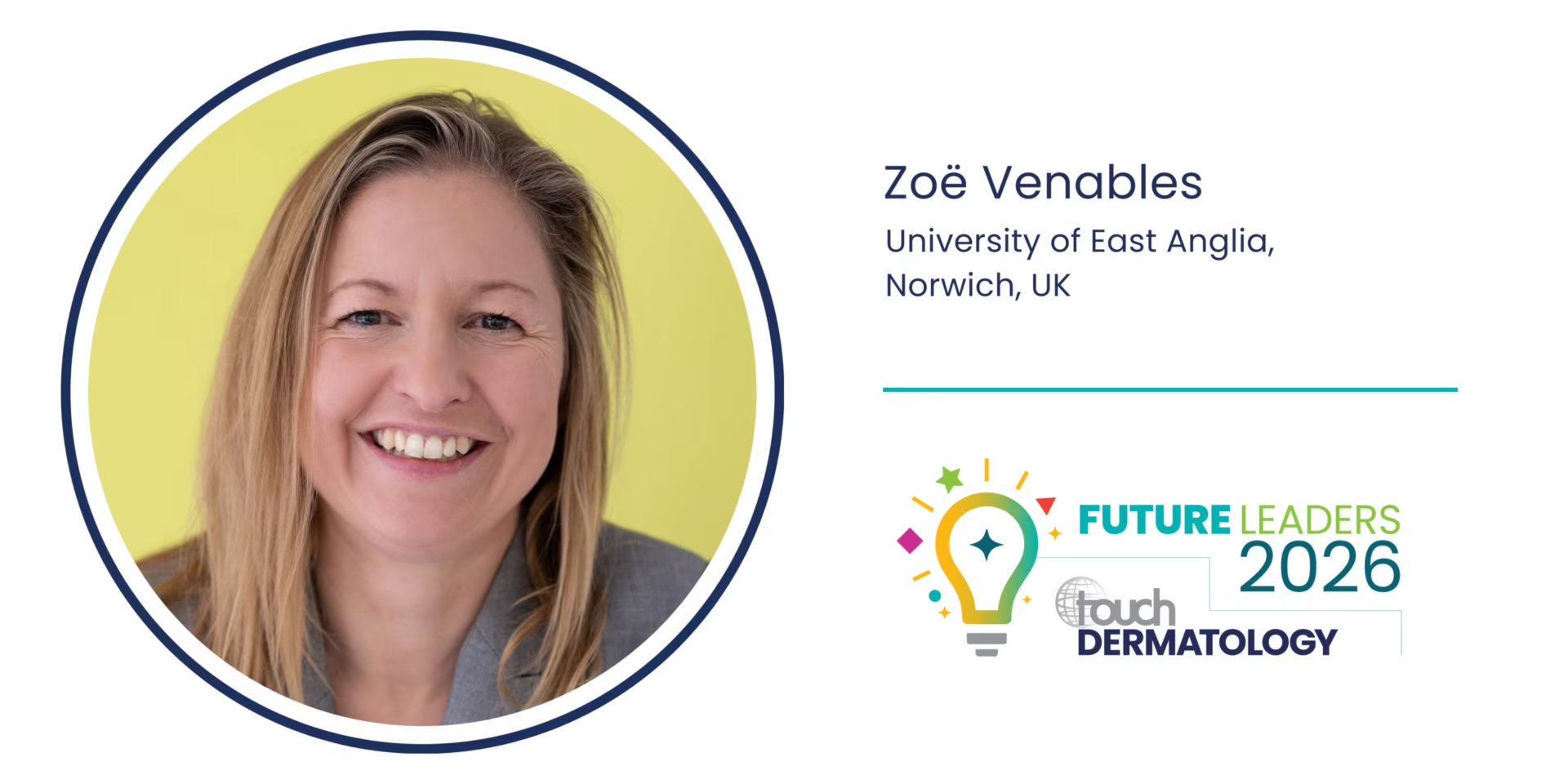
We are delighted to announce Dr Zoë Venables as a touchDERMATOLOGY Future Leader 2026.
Dr Zoë Venables is a Consultant Dermatologist and Clinical Associate Professor at the University of East Anglia, Norwich, UK. She is Clinical Lead for Dermatology at NHS England’s National Disease Registration Service (NDRS), where she leads work using national data to improve understanding of skin cancer incidence, treatment, and outcomes.
Before this work, routine national statistics were unavailable for basal cell carcinoma (BCC) and cutaneous squamous cell carcinoma (cSCC), the UK’s two most common cancers. Dr Venables has helped establish these data while developing new approaches to improve outcomes, including a metastatic cSCC risk calculator and AI research into associations between medications and cSCC risk. Her work is also expanding to rare and under-reported conditions, including epidermolysis bullosa, where national datasets can generate insights that would be difficult to obtain from individual centers alone.
She has received Young Investigator Awards from the British Skin Foundation and British Society for Investigative Dermatology, as well as a National Clinical Impact Award. She also contributes to national guidelines and care pathways and is developing an academic dermatology pathway in Norwich to support future research leaders.
In this Q&A, Dr Venables discusses what drew her to dermatology, the mentors who shaped her research career, and how big data and AI could improve care while presenting important questions about evidence and health inequalities.
Q: What drew you to dermatology, and how did your interest in your current area of focus develop?
When I was a first-year doctor, I hadn’t quite made up my mind what I wanted to do. I started to look at which clinicians seemed happiest in their work, and almost every dermatologist I met appeared to genuinely enjoy what they did.
I loved that dermatology relies so much on clinical skill. Often, you don’t need an array of tests to work out what is going on. You look, you listen, you use your experience and you put the pieces together. There are also so many rare and unusual diagnoses to discover, so you are constantly learning. And importantly, we have some fantastic treatments and can make a real difference to patients, which is incredibly rewarding.
A four-month GP job during Foundation Year 2 (FY2) probably sealed the deal. I found having to know a little about everything surprisingly stressful, and I didn’t sleep particularly well worrying about what I might have missed. I realized that I work much better when I can develop deep expertise in an area. And, if I’m honest, although I was capable, I realized I didn’t enjoy the pressure of acute emergencies either.
My interest in skin cancer developed later, as I became fascinated by the bigger questions behind the patients I was seeing: who gets skin cancer, why, how we can improve outcomes, and whether we can use data to make the health service better. Once I started working in skin cancer epidemiology, I discovered that I also loved numbers and spreadsheets and genuinely enjoyed spending my evenings looking at large datasets to find patterns that are clinically meaningful and could make a real difference to patient care.
That has gradually developed into a broader interest in using large-scale health data to tackle questions that are difficult to answer in routine clinical practice, from identifying patients at risk of poor outcomes to understanding rare and under-reported diseases where better data could make a real difference.
Q: Is there a specific patient, mentor, or experience that shaped your path in this field?
One person who had a huge influence on me was Prof. Richard Weller, who was a lecturer when I was studying medicine in Edinburgh. He is extraordinarily enthusiastic about dermatology and research, and his enthusiasm was infectious. He made research feel like exploration rather than work, and I wanted to follow in his footsteps.
After FY2, I did a Masters in Medical Research with Richard as my supervisor. I have to admit, I discovered that I really didn’t like laboratory work! But I did begin to understand what he loved about research: asking questions, challenging what we think we know, and discovering something that nobody knew before.
As my clinical career developed in Norwich and Leicester, Nick Levell, George Millington, Karen Harwood, and Graham Johnston were hugely supportive of my clinical development.
I have also been fortunate to have some inspirational female dermatology research leaders and role models around me. Prof. Irene Leigh, Prof. Charlotte Proby, and Prof. Catherine Harwood have all been incredibly generous with their time, advice, and encouragement, and helped give me the confidence and opportunities to take the next steps in my research career.
I think that is one of the great things about dermatology: people are often remarkably generous in helping the next generation find their way, and I’m determined to pay that forward.

“The fact that something can be done with AI does not necessarily mean that it should be, and we need good evidence that new technologies genuinely improve patient care and do not inadvertently widen inequalities.”
Zoë Venables
Q: What current innovations in dermatology excite you the most?
There is so much happening in dermatology at the moment that it is difficult to pick just a few. Therapeutic advances are particularly exciting. Immunotherapy has already transformed the treatment of advanced melanoma and other skin cancers, and I am fascinated by where this could go next, including personalized approaches such as the vaccines we are currently trialing for melanoma.
AI is another area that I think will fundamentally change dermatology. AI-assisted diagnosis has obvious potential, but I am equally interested in the less glamorous applications. If AI can help triage referrals, analyze large datasets, or take away some of the repetitive administrative tasks that consume clinicians’ time, it could make a huge difference to how we work.
I’m particularly interested in the potential for AI and large datasets to help us answer questions that have traditionally been difficult to study. This could be particularly valuable in rare and under-reported diseases, where individual centers may see too few patients to generate meaningful evidence, but larger datasets can start to reveal important patterns.
But we need to tread carefully. The fact that something can be done with AI does not necessarily mean that it should be, and we need good evidence that new technologies genuinely improve patient care and do not inadvertently widen inequalities.
I suspect that, 10 or 20 years from now, our jobs will look very different. That is both exciting and slightly terrifying! For me, the challenge is making sure that as technology changes how we practice, we retain the clinical judgment, human connection, and curiosity that make dermatology such a rewarding specialty.
Disclosures: This short article was prepared by touchDERMATOLOGY in collaboration with Dr Venables. No fees or funding were associated with its publication.
Citation: Dr Zoë Venables on turning big data into better skin cancer outcomes: touchDERMATOLOGY Future Leaders 2026. touchDERMATOLOGY. XX September 2026.
Register now to receive the touchDERMATOLOGY newsletter!
Don’t miss out on hearing about our latest peer reviewed articles, expert opinions, conference news, podcasts and more.