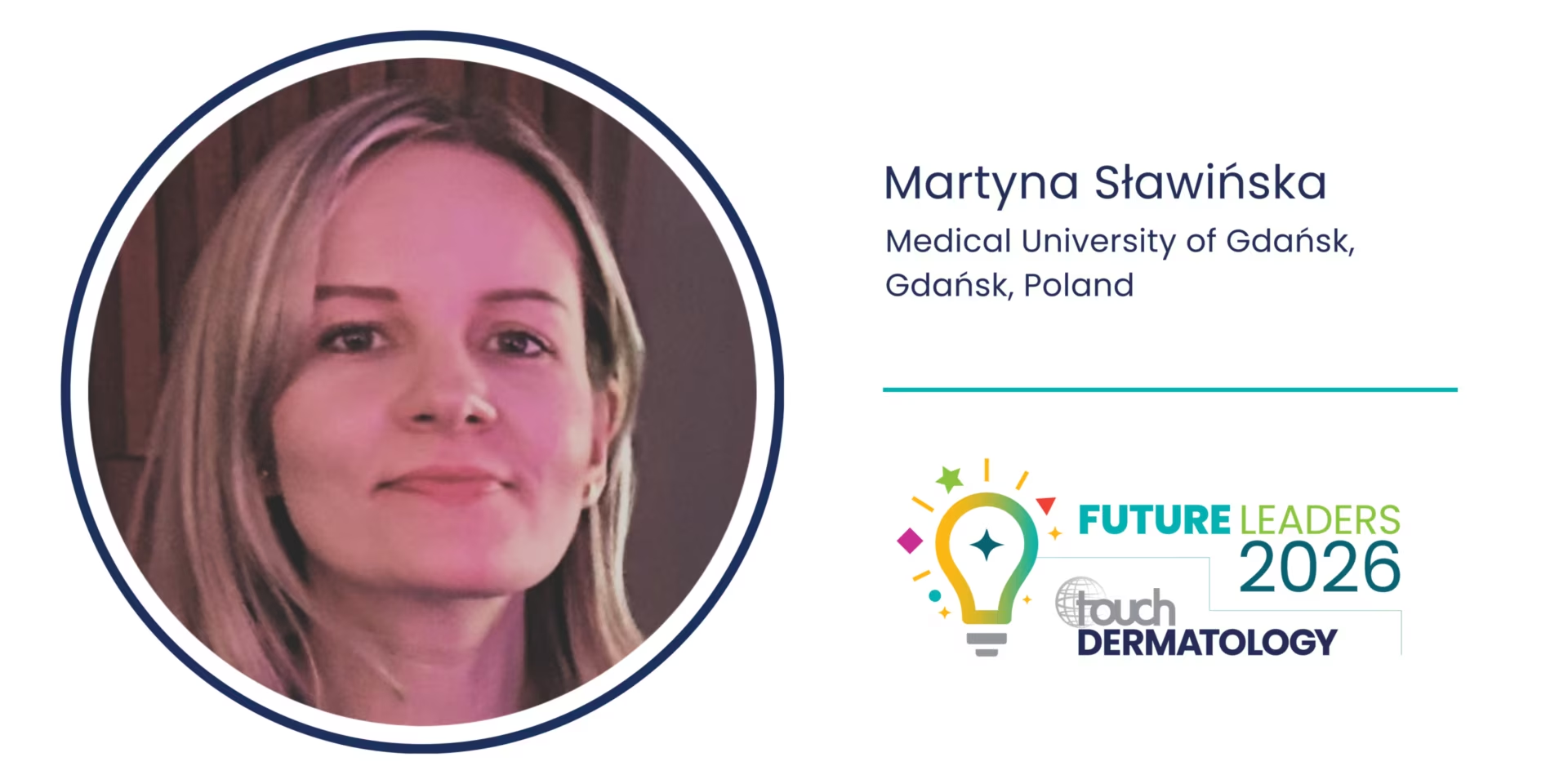
We are delighted to announce Dr Martyna Sławińska as a touchDERMATOLOGY Future Leader 2026.
Dr Martyna Sławińska is advancing the field of dermatology through her work on non-invasive skin imaging and its application beyond skin cancer.
Based at the Medical University of Gdańsk, Poland, Dr Sławińska is Associate Professor in the Department of Dermatology, Venereology and Allergology, where she co-founded the department’s reflectance confocal microscopy laboratory. Her clinical and research interests center on dermoscopy, trichoscopy, and confocal microscopy as well as hair and nail disorders, dermatologic surgery, and cutaneous oncology.
A board-certified dermatologist, she has authored numerous peer-reviewed publications and abstracts and holds two patents in dermatological innovation. She has trained internationally in Lyon, Trieste, Rome, Gothenburg, Reggio Emilia, and Buenos Aires. In Gdańsk, she supervises doctoral candidates and her department’s student research group, and runs hands-on dermoscopy workshops for medical students and practicing physicians.
Q: What drew you to dermatology, and how did your interest in your current area of focus develop?
Two things, on more or less the same day, during my studies in Poznań, Poland.
The first was a patient with a basal cell carcinoma on his nose. My immediate thought was that removing it would be extremely challenging and could result in significant facial disfigurement. Then I watched the defect being closed with a flap, and it was almost invisible. I had not known that was possible.
The second was the dermatoscope. I remember being genuinely surprised that something so simple, something that costs almost nothing compared with the machines we use elsewhere in medicine, could change what you decide to do for a patient.
After that, my decision was very specific. I did not apply for a dermatology residency in general; I applied to one place, the dermatosurgery unit created by Prof. Adam Włodarkiewicz in Gdańsk, because at the time it was the best in Poland. That is where dermoscopy, nail disorders, and surgery came together for me.
Q: Is there a specific patient, mentor, or experience that shaped your path in this field?
Four mentors have shaped my path, in four completely different ways. Prof. Roman Nowicki, the head of our department, gave me the space to grow in this field. Prof. Michał Sobjanek has been a daily collaborator for a decade: my PhD supervisor, and the person with whom I built the confocal lab with. Prof. Małgorzata Sokołowska-Wojdyło, a model of expertise, hard work, and empathy, has helped me at several decisive moments in my career. Finally, Prof. Luc Thomas in Lyon taught me nail unit surgery, something I feel very few dermatologists actually practise. He also set my standard for what rigorous academic work should look like.
In terms of a specific patient, I often think about a man in his thirties who was experiencing homelessness and had a history of psoriasis. He was admitted with presumed psoriatic erythroderma, and clinically, that was exactly what it appeared to be. However, videodermoscopy revealed multiple delta signs, indicating crusted scabies. What stays with me is what might have happened otherwise: he would have received immunosuppressive treatment for scabies. That case is a large part of why I later focused my work on dermoscopy in erythroderma.
Q: What current innovations in dermatology excite you the most?
For me, it has always been noninvasive skin imaging, and it still is. That is the thread running through everything I do, including dermoscopy, trichoscopy and reflectance confocal microscopy. Much of my work has focused on applying these tools in areas where they were not previously used, such as cutaneous lymphomas, mastocytosis and erythroderma.
What excites me now is that artificial intelligence is taking the field into a genuinely new era. We are moving from a tool that supports one clinician’s judgment to something that could change diagnostic access on a scale we have not seen before. If it is developed in the right direction, I think it will help a great many people with skin cancer.
From October, I will be working on exactly this topic during a research appointment at Memorial Sloan Kettering Cancer Center in New York, with Dr Ashfaq A. Marghoob and Dr Allan Halpern.

“Much of my work has focused on applying these tools in areas where they were not previously used, such as cutaneous lymphomas, mastocytosis and erythroderma.”
Martyna Sławińska
Disclosures: This short article was prepared by touchDERMATOLOGY in collaboration with Dr Sławińska. No fees or funding were associated with its publication.
Citation: Dr Martyna Sławińska on non-invasive imaging and the future of skin cancer diagnosis: touchDERMATOLOGY Future Leaders 2026. touchDERMATOLOGY. XX September 2026.
Register now to receive the touchDERMATOLOGY newsletter!
Don’t miss out on hearing about our latest peer reviewed articles, expert opinions, conference news, podcasts and more.